


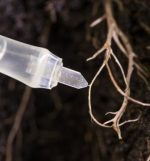
Summary:A drug delivery ion pump constructed from organic electronic components also works in plants. Researchers have used such an ion pump to control the root growth of a small flowering plant, the thale cress (Arabidopsis thaliana).
A drug delivery ion pump constructed from organic electronic components also works in plants. Researchers from the Laboratory of Organic Electronics at Linköping University and from the Umeå Plant Science Centre have used such an ion pump to control the root growth of a small flowering plant, the thale cress (Arabidopsis thaliana).
In the spring of 2015, researchers from the Laboratory of Organic Electronics at Linköping University presented a micro fabricated ion pump with the ability to pump in the correct dose of a naturally occurring pain-relief agent exactly where it was needed. This was a first step towards effective treatment of such conditions as chronic pain. In the autumn of the same year, the researchers presented results showing how they had caused roses to absorb a water-soluble conducting polymer, enabling them to create a fully operational transistor in the rose stem. The term “flower power” suddenly took on a whole new meaning.
“Around 10 years ago, we started considering applying our ion pump drug delivery devices to plants. It wasn’t until several years later that we teamed up with Professor Markus Grebe and colleagues at the Umeå Plant Science Centre and finally discovered that the ion pump could be of great use to plant biologists, says Daniel Simon, Associate Professor and head of the organic bioelectronics research area in the Laboratory of Organic Electronics, Linköping University.
Assistant Professor David Poxson, Laboratory of Organic Electronics, teamed up with the group´s chief chemist, Assistant Professor Roger Gabrielsson, to develop new ion pump materials capable of transporting and delivering powerful plant signalling compounds such as the hormone auxin.
Dr. Poxson then worked closely with biologists at the Umeå Plant Science Centre to investigate highly-resolved delivery of auxin to the roots of living thale cress, Arabidopsis thaliana. This plant is to plant biologists what the fruit fly Drosophila is to researchers working in animal research: a major model organism.
The result: Electronically-controlled gradients of plant hormone were taken up by the roots. Dr. Poxson and co-author Dr. Michal Karady followed the internal auxin response with the help of fluorescent reporter proteins that change their fluorescence intensity in the presence of auxin. They observed that the internal auxin response and even the roots´ growth rate could be controlled by the ion pump delivery of auxin.
“We have accomplished a ground-breaking step for plant research by our multidisciplinary effort,” says Markus Grebe. “Several research groups from Umeå Plant Science Centre and Linköping University have been involved. The pump will likely allow us to locally apply not only auxin but also a variety of other hormones to plants in an electronically controlled manner. This will help us to study the impact of these hormones on plant growth and development at tissue and cellular resolution.”
“These new DendrolyteTM materials also paves the way for future ion pump capabilities in a variety of areas, for example delivery of larger aromatic compounds like plant hormones or even certain pharmaceuticals,” says Daniel Simon.
“This is an important advance: we now know not only that we can use the ion pump in plants, but also that we can regulate their physiology and growth,” says Professor Magnus Berggren, head of the Laboratory of Organic Electronics
More:Science