


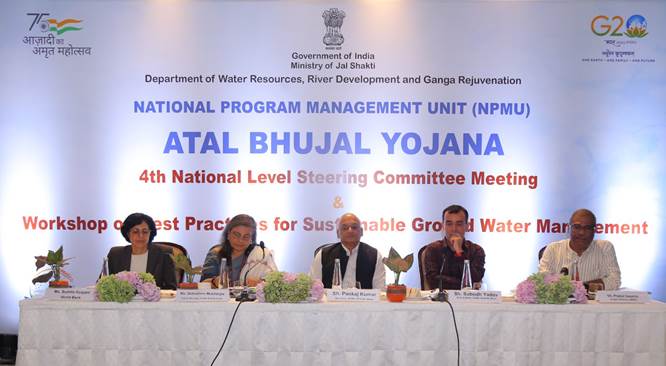
The fourth meeting of the National Level Steering Committee (NLSC) of the Atal Bhujal Yojana was recently held in New Delhi under the Chairmanship of Pankaj Kumar IAS. Atal Bhujal Yojana (ATAL JAL) is a Central Sector Scheme that has been implemented since April 2020 in water-stressed Gram Panchayats across seven states: Gujarat, Haryana, Karnataka, Madhya Pradesh, Maharashtra, Rajasthan, and Uttar Pradesh. The scheme aims to improve water security in these areas over a five-year period (2020-2025).
During the meeting, the committee reviewed the progress of the scheme and directed the states to expedite all activities, including procurement and convergence, to implement the interventions proposed under Water Security Plans (WSPs). The committee acknowledged that the initial two years of scheme implementation were hampered by the COVID-19 pandemic. It was decided that the scheme should be extended for another two years beyond the existing timeline to ensure effective community behavioral change, which is a time-consuming process.
The Secretary of the Department of Water Resources (DoWR), Pankaj Kumar, expressed satisfaction with the overall performance of the scheme and highlighted the achievements under the Disbursement Linked Indicators. He emphasized the need for states to adopt innovative technologies in irrigation to increase water efficiency. He instructed the states to map drinking water sources and conduct studies to assess their sustainability and how interventions under Atal Jal can support these sources.
The importance of capacity building for communities involved in the scheme was also emphasized during the meeting. The Special Secretary of the DoWR, Ms. Debashree Mukherjee, stressed the need to assess the quality of training provided at the Gram Panchayat level. She requested participating states to integrate WSPs into the Gram Panchayat Development Plans (GPDPs) to ensure the sustainability of the scheme’s approach even after its completion.
The Practice Manager of the World Bank praised the scheme for its focus on water use efficiency and noted the progress made over the past three years. She emphasized the importance of community-led sustainable groundwater management and expressed full support for the scheme.
The meeting was attended by senior officers from the seven states where the scheme is being implemented, as well as line departments involved in the committee. The NLSC meeting was followed by a workshop on best practices in sustainable groundwater management, where each state presented their best practices in groundwater recharge, efficient water use, innovative irrigation technologies, public disclosure of data, and other interventions implemented under Atal Bhujal Yojana.
One of the key aspects of ATAL JAL is to bring about behavioral changes in the community, shifting from a consumption-oriented attitude to conservation and smart water management. Communities at the Gram Panchayat level are being assisted in collecting water-related data and preparing Water Budgets and Water Security Plans (WSPs). These plans reflect the communities’ demand and supply side interventions to be implemented by various line departments through convergence. The scheme aims to bring all line departments working in the water sector together to effectively utilize resources in implementing the WSPs. It also emphasizes interventions that reduce water demand in irrigation and aims to bring 4.5 lakh hectares of irrigated area under efficient water techniques such as drip/sprinkler irrigation, pipeline irrigation, mulching, and crop diversification. The scheme follows a challenge method, where states that perform well can receive more incentive funds. Performance is measured through predefined targets called Disbursement Linked Indicators, which determine incentive disbursement to states.