


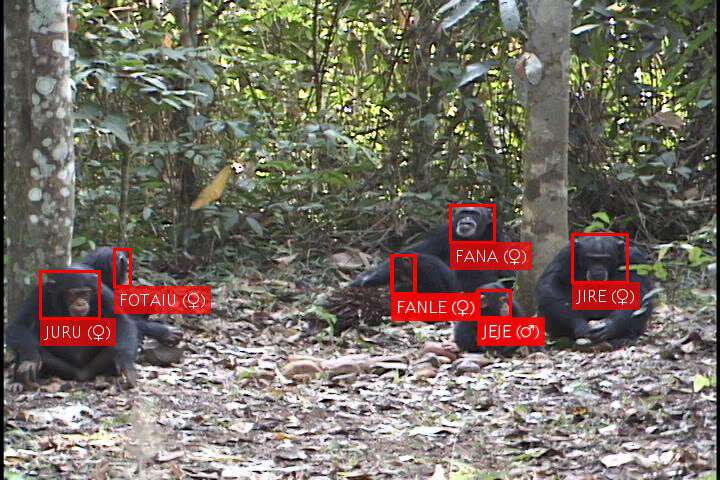
Summary:Scientists have developed new artificial intelligence software to recognize and track the faces of individual chimpanzees in the wild. The new software will allow researchers and wildlife conservationists to significantly cut back on time and resources spent analyzing video footage, according to the new article.
Scientists at the University of Oxford have developed new artificial intelligence software to recognise and track the faces of individual chimpanzees in the wild. The new software will allow researchers and wildlife conservationists to significantly cut back on time and resources spent analysing video footage, according to the new paper published today in Science Advances.
‘For species like chimpanzees, which have complex social lives and live for many years, getting snapshots of their behaviour from short-term field research can only tell us so much,’ says Dan Schofield, researcher and DPhil student at Oxford University’s Primate Models Lab, School of Anthropology. ‘By harnessing the power of machine learning to unlock large video archives, it makes it feasible to measure behaviour over the long term, for example observing how the social interactions of a group change over several generations.’
The computer model was trained using over 10 million images from Kyoto University’s Primate Research Institute (PRI) video archive of wild chimpanzees in Guinea, West Africa. The new software is the first to continuously track and recognise individuals in a wide range of poses, performing with high accuracy in difficult conditions such as low lighting, poor image quality and motion blur.
‘Access to this large video archive has allowed us to use cutting edge deep neural networks to train models at a scale that was previously not possible,’ says Arsha Nagrani, co-author of the study and DPhil student at the Department of Engineering Science, University of Oxford. ‘Additionally, our method differs from previous primate face recognition software in that it can be applied to raw video footage with limited manual intervention or pre-processing, saving hours of time and resources.’
The technology has potential for many uses, such as monitoring species for conservation. Although the current application focused on chimpanzees, the software provided could be applied to other species, and help drive the adoption of artificial intelligence systems to solve a range of problems in the wildlife sciences.
‘All our software is available open-source for the research community,’ says Nagrani. ‘We hope that this will help researchers across other parts of the world apply the same cutting-edge techniques to their unique animal data sets. As a computer vision researcher, it is extremely satisfying to see these methods applied to solve real, challenging biodiversity problems.’
‘With an increasing biodiversity crisis and many of the world’s ecosystems under threat, the ability to closely monitor different species and populations using automated systems will be crucial for conservation efforts, as well as animal behaviour research’ adds Schofield. ‘Interdisciplinary collaborations like this have huge potential to make an impact, by finding novel solutions for old problems, and asking biological questions which were previously not feasible on a large scale.’
More: Science Daily