


PIB News Update: Pineapple-based agroforestry, traditionally practiced by ethnic “Hmar” tribe in southern Assam, can be a sustainable alternative to jhum cultivation for the North East India. This traditional practice can provide twin solutions for climate change and biodiversity loss, according to a new study.
Jhum cultivation, also called swidden agriculture, the dominant agricultural practice in the region, has become unsustainable primarily due to the reduced fallow cycle resulting in depletion in soil fertility, severe soil erosion, and low agronomic productivity. Hence, North East India and many south Asian countries are shifting to agroforestry and high-value cropping systems from traditional jhum practices over the past decades, which are considered sustainable and profitable alternatives. Researchers are looking for agroforestry options that would also offer high C storage potential and tree diversity to couple this with solutions for challenges of climate change and biodiversity loss.
Pineapple agroforestry systems (PAFS) are dominant land use in the Indian Eastern Himalayas and other parts of Asia and are mostly grown in association with multipurpose trees. The ethnic “Hmar” tribe in southern Assam have been cultivating pineapple for centuries. At present, they practice the indigenous PAFSfor, both home consumption and boosting economic benefits. They have applied traditional knowledge to evolve a unique agroforestry system.
The recent study carried out by the Department of Ecology and Environmental Science, Assam University, Silchar, with support from the Climate Change Program Division of the Department of Science & Technology, GoI, assessed the tree diversity and ecosystem carbon storage through traditional agroforestry system practised by the local communities. It showed that the system they practice maintains a steady ecosystem carbon stock while reducing land-use-related carbon emission and providing additional co-benefits to the communities.
The study by a research team led by Arun Jyoti Nath, Associate Professor in the Department of Ecology and Environmental Science, Assam University, Silchar was conducted in the ethnic villages located in the Cachar district of Assam, part of the Himalayan foothills and the Indo-Burma centre of global biodiversity hotspot to explore changes in tree diversity and transition of dominant tree species from swidden agriculture through different aged PAFS. The changes in the biomass carbon and ecosystem carbon storage in tree and pineapple components from swidden agriculture through different aged PAFSwere also noted.
It was found that farmers apply traditional knowledge for tree selection through prior knowledge and long-term farming experience. Additionally, fruit trees such as Areca catechu and Musa species are planted on farm boundaries as live fences. The live fence reduces soil erosion and acts as a windbreak and shelterbelt. A combination of economically important trees like Albiziaprocera, Parkiatimoriana, Aquilariamalaccensis, as well as fruit trees like papaya, lemon, guava, litchi, and mango with pineapple caters for both home-consumption and selling all year round. The upper canopy trees regulate light, enhance biomass inputs, and increase farm diversity, resulting in soil fertility and improved plant nutrition. The tree-related management practices promote the conservation of the farmers’ favoured indigenous fruit trees. In the older pineapple agroforestry farms, farmers introduce rubber trees.
The research shows that the practice can be applied for the REDD+ mechanism to add to the carbon capturing and reducing deforestation by contributing to tree cover, which may further incentivise against the carbon credit to the poor farmers.
The study published in the ‘Journal of Environmental Management’ recently can provide information about emission factor for the indigenous agro-ecosystems in North East India for mitigation purposes, which may also facilitate the formulation of incentives for the communities under the REDD + mechanism. It would also equip forest managers with information for accounting the changes in the C storage due to deforestation and jhum cultivation.
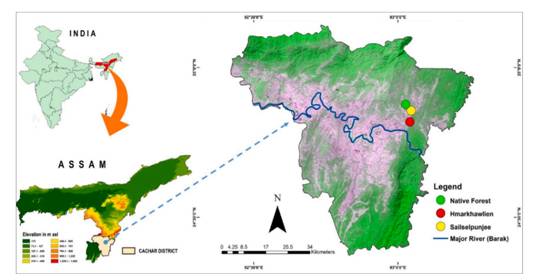
Fig: Map showing locations of the study area (Image taken from the research publication)
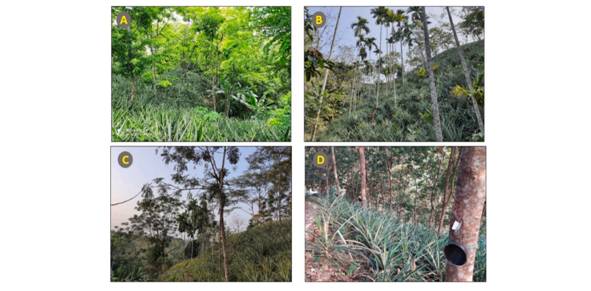
Fig: Representative filed images of the tree species examined under the traditional PAFS (Image taken from the research publication)
Publication link:
https://doi.org/10.1016/j.jenvman.2021.113470
For more details, Dr. Arun Jyoti Nath ([email protected]) can be contacted.