


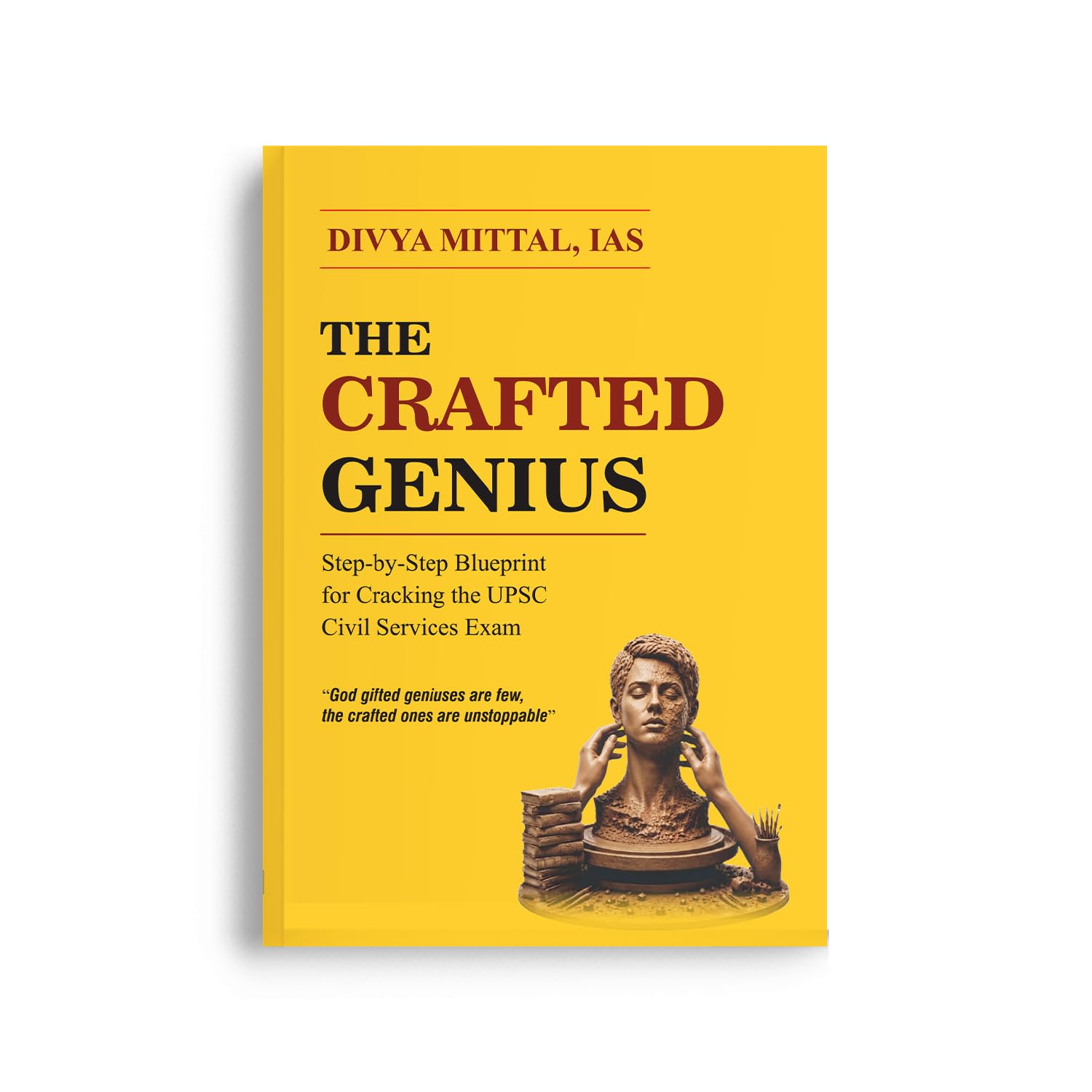
The Crafted Genius- Editorial Assessment of a Structured Approach to UPSC Preparation
The UPSC Civil Services Examination is often described as a test of knowledge, but that description is incomplete. It is equally a test of consistency, judgement, analytical ability, written communication and the capacity to sustain performance over a prolonged period of preparation. It is in this context that The Crafted Genius, authored by Divya Mittal, IAS, seeks to make its contribution.

The book is not positioned merely as another collection of preparation tips. Its broader proposition is that success in the Civil Services Examination can be approached as a structured process of learning, habit formation and execution. This is an important proposition in an examination ecosystem where aspirants are frequently overwhelmed by the sheer volume of available information, coaching material and competing advice.

From the perspective of the IndianBureaucracy.com Editorial Team, the book’s principal strength lies in its attempt to bring these disparate elements together into a single framework. Rather than treating UPSC preparation as a series of disconnected stages, The Crafted Genius approaches the journey as a system—beginning with understanding the examination, moving through planning and preparation, and ultimately extending to revision, answer writing, interview preparation and personal sustainability.
The author brings considerable first-hand experience to this exercise. Divya Mittal, IAS, an alumna of IIT Delhi and IIM Bangalore, worked as a corporate professional in London before entering the civil services. She cleared the UPSC Civil Services Examination three times through self-study, securing the IRS, IPS and IAS in three consecutive years. While personal success alone does not automatically translate into a universally applicable preparation method, this experience gives the book a distinctive foundation and allows the author to examine the examination from the perspective of repeated preparation and performance.
Who is Divya Mittal | Click here to see profile
The central idea suggested by the title is also the book’s most significant theme: excellence is crafted rather than simply inherited. In the context of UPSC preparation, this argument has considerable relevance. Academic background, access to resources and individual aptitude undoubtedly influence preparation, but sustained performance depends equally on the ability to build effective systems and follow them consistently.
The book therefore shifts attention away from the search for a single secret strategy and towards the more demanding questions of how aspirants plan, study, revise, practise and evaluate themselves.
Understanding the Examination Before Preparing for It
One of the most valuable aspects of The Crafted Genius is its emphasis on understanding what the UPSC is actually testing. This is a question that is often overlooked by aspirants at the beginning of their preparation.
The examination is not simply a test of how much information a candidate can memorise. Its different stages demand different capabilities. The Preliminary Examination requires breadth of knowledge, accuracy and decision-making under pressure. CSAT demands a level of focused preparation that should not be ignored merely because it is qualifying. The Mains Examination tests analytical thinking, written expression, depth of understanding and the ability to construct a coherent response within strict time and word limits. The Personality Test requires awareness, balance, clarity and the ability to engage with issues in a thoughtful manner.
A candidate who approaches all these stages with a single preparation method is unlikely to extract the best from each stage. The book’s attempt to create a framework that recognises these differences is therefore a significant strength.
The proposed 60-day launch plan is particularly relevant for beginners. The initial phase of UPSC preparation is often marked by confusion. Aspirants are confronted with questions about sources, current affairs, optional subjects, test series and study schedules before they have even developed a clear understanding of the examination.
A structured beginning can help reduce this confusion. The value of such a plan, however, lies not in following a timetable mechanically, but in using it to establish direction, priorities and sustainable study habits.
From Information to Execution
The distinction between knowing and performing is central to any serious discussion of UPSC preparation. Many aspirants read extensively, accumulate notes and follow multiple sources, but struggle to translate their knowledge into performance in the examination.
This is where the book’s emphasis on execution becomes particularly important.
The Mains examination requires more than information. A good answer must demonstrate relevance, structure, analysis, balance and clarity. It must respond directly to the question and present a considered argument within the limitations of time and word count.
Similarly, the Essay paper requires the ability to think broadly and develop a coherent line of argument. Ethics demands conceptual clarity, practical application and the ability to engage with real-life administrative situations.
These abilities cannot be developed through passive reading alone. They require practice, feedback, reflection and repeated refinement. The book’s broader framework recognises this essential transition from preparation to performance.
This is perhaps one of the most important lessons for aspirants: preparation is ultimately measured by what a candidate can produce under examination conditions.
The Question of the Optional Subject
The selection of the Optional subject is another area in which aspirants often face considerable uncertainty. Choices are frequently influenced by trends, the success of individual candidates or perceptions about the scoring potential of a particular subject.
A more rational approach requires candidates to examine their academic background, genuine interest, familiarity with the subject, availability of resources and the nature of the syllabus.
The importance of the decision lies not in identifying a universally “best” Optional subject, but in identifying the subject that can be prepared effectively by a particular candidate. This is consistent with the book’s wider philosophy of replacing imitation with informed decision-making.
Preparation as a System of Habits
Perhaps the most practical dimension of The Crafted Genius is its focus on habits and discipline.
The UPSC preparation journey is long. It cannot be sustained by motivation alone. Motivation may help a candidate begin, but discipline and systems determine whether preparation continues when motivation declines.
This is a reality that many aspirants encounter. There are productive days and unproductive days, periods of confidence and periods of doubt, as well as moments when the sheer scale of the examination becomes overwhelming.
A sustainable preparation strategy therefore requires the management of time, attention and energy. It requires the ability to establish routines, minimise distractions, review progress and make adjustments when a strategy is not working.
The book’s emphasis on these fundamentals is one of its most useful features. It directs attention away from the constant search for new material and towards the more difficult task of consistently implementing an existing plan.
The Importance of Mental Well-Being
Any contemporary discussion of UPSC preparation must also acknowledge its psychological demands. The examination can involve prolonged uncertainty, repeated setbacks, social comparison and considerable pressure.
A preparation system that focuses exclusively on study hours while ignoring mental well-being is incomplete.
The book’s attention to focus, balance and psychological sustainability adds an important dimension to its approach. The objective is not simply to study for longer periods, but to develop a method that can be sustained over time.
This is particularly relevant in an environment where aspirants may equate productivity with the number of hours spent at a desk. In reality, effective preparation also depends on the quality of concentration, the ability to recover from setbacks and the capacity to maintain consistency over the long term.
A Book for Aspirants at Different Stages
Another strength of The Crafted Genius is its relevance to candidates at different stages of the journey.
For school and college students, the book offers a perspective on building strong foundations. This need not mean beginning intense examination-oriented preparation prematurely. It can instead involve developing reading habits, writing ability, general awareness, curiosity and discipline.
For active aspirants, the book addresses the practical challenge of managing the daily demands of preparation. Many candidates do not suffer from a shortage of resources. Their greater challenge is often the absence of a clear system for using those resources.
The tendency to constantly change books, teachers, courses and strategies can itself become a form of distraction. A structured approach can help aspirants focus on consistency over constant experimentation.
For repeat candidates, the book’s framework can encourage a more analytical approach to another attempt. A new attempt should ideally not simply reproduce the preparation of the previous attempt. Candidates must identify weaknesses, examine their strategy honestly and make targeted changes.
In that sense, failure can be treated not merely as a setback but as information that can inform a better strategy.
The Value of the Author’s Journey
The author’s personal journey gives the book an additional dimension. An alumna of IIT Delhi and IIM Bangalore, Divya Mittal also worked as a corporate professional in London before pursuing the civil services. Her eventual success through dedicated self-study demonstrates that there is no single conventional route to the UPSC.
Her repeated success in the examination, securing the IRS, IPS and IAS in consecutive years, provides a rare perspective on preparation across multiple attempts and stages of the examination.
However, the book’s value does not rest solely on the author’s achievements. The more important question is whether the experience has been converted into principles that other aspirants can understand and adapt.
On this count, the book’s emphasis on systems, discipline and execution gives it wider relevance. It does not suggest that every aspirant can simply replicate the author’s exact path. Instead, it encourages readers to examine the principles behind effective preparation and adapt them to their own circumstances.
Going Beyond the Search for Shortcuts
One of the most positive aspects of The Crafted Genius is that it does not appear to promise shortcuts.
The UPSC Civil Services Examination remains a demanding test that requires sustained effort. No book can eliminate the need for study, revision and practice. What a good preparation guide can do is help candidates use their effort more intelligently.
This distinction is important.
Thousands of aspirants work hard every year. The difference often lies in whether that effort is directed towards the right priorities, supported by effective revision, tested through practice and adjusted through honest self-assessment.
In this sense, The Crafted Genius can be viewed as an attempt to provide an operating system for UPSC preparation. It brings together the major components of the journey—understanding the examination, building a plan, studying effectively, revising systematically, practising answer writing, managing time, maintaining focus and protecting mental well-being.

Editorial Assessment
From an editorial perspective, the book’s strongest contribution lies in its attempt to make UPSC preparation more structured, deliberate and self-aware.
Its central argument—that excellence is built through consistent systems rather than talent alone—is neither entirely new nor exclusive to the civil services. However, its value lies in applying that principle to the specific demands of the UPSC examination and presenting it through the author’s unusual personal experience.
The book is likely to be most useful to readers who approach it as a framework rather than a formula. No strategy can eliminate the need for individual judgement. Different aspirants have different academic backgrounds, learning styles, strengths and weaknesses. The most effective preparation will therefore always involve adaptation.
What the book offers is a basis for that adaptation.
For beginners, it provides direction. For active aspirants, it offers structure. For repeat candidates, it encourages reflection and strategic correction. Its most important message is that preparation should not be reduced to the accumulation of information. It must also involve the development of habits, judgement, discipline and execution.
The UPSC Civil Services Examination is undoubtedly demanding. It requires knowledge, endurance, patience, analytical ability and resilience. But The Crafted Genius makes a compelling case that success is not simply the product of an extraordinary mind.
It is also the result of ordinary actions performed with extraordinary consistency. That is the book’s most powerful message.
The Crafted Genius does not merely ask aspirants to study harder. It asks them to prepare better—to understand the examination, build a system, identify weaknesses, develop sustainable habits and repeatedly improve their execution.
For an examination in which the difference between success and failure can often lie in the quality of preparation and performance, this is a message of considerable relevance.
The IndianBureaucracy.com Editorial Team’s assessment is that The Crafted Genius will be of greatest value to aspirants who are willing to move beyond the search for a magical strategy and engage with the more demanding work of building a disciplined, personalised and sustainable preparation system.
Its central proposition remains both simple and significant:
Genius may be a starting point for some. Excellence, however, can be crafted.
IndianBureaucracy.com wishes the very best !!
Available at: Amazon: amzn.in/d/010oIU1r Nageen: bit.ly/3SMuppD