


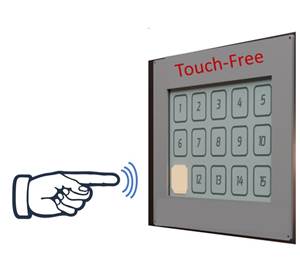
Indian Scientists have provided an affordable solution to develop a low-cost touch-cum-proximity sensor popularly called touchless touch sensor through a printing technique.
The coronavirus pandemic has triggered efforts to make our lifestyle more adaptable to pandemic scenarios. Actions are naturally driven to strategies to reduce the risk of viruses spreading, particularly in public places where touchscreens on self-service kiosks, ATMs, and vending machines are nearly inevitable.
Recently Bengaluru based scientists from the Centre for Nano and Soft Matter Sciences (CeNS), and Jawaharlal Nehru Centre for Advanced and Scientific Research (JNCASR), autonomous institutes of the Department of Science & Technology (DST), Government of India, has set up a semi-automated production plant for the production of printing-aided patterned (resolution of around 300 µm) transparent electrodes, which has the potential for being utilized in advanced touchless screen technologies.
This work by the team led by Prof. G U Kulkarni and co-workers and funded by DST-Nanomission at CeNS has been published recently in the journal ‘Materials Letters’ recently. Dr. Ashutosh K Singh, a scientist working on this project, said, “We have fabricated a touch sensor which senses a proximal or hover touch even from a distance of 9 cm from the device”.
“We are making a few more prototypes using our patterned electrodes to prove their feasibility for other smart electronic applications. These patterned electrodes can be made available to interested industries and R&D labs on a request basis to explore collaborative projects,” said Dr. Indrajit Mondal, another co-author in the research.
The novel low-cost patterned transparent electrodes have tremendous potential to be used in advanced smart electronic devices like touchless screens and sensors. This touchless touch sensor technology could assist in preventing the spread of viruses that spread through contact.
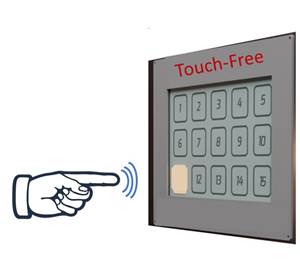
Figure: Schematic demonstration of touchless touch sensor
Publication details: DOI:10.1016/j.matlet.2022.131724
For more technical details: Dr. Ashutosh K Singh ([email protected]) can be contacted.