


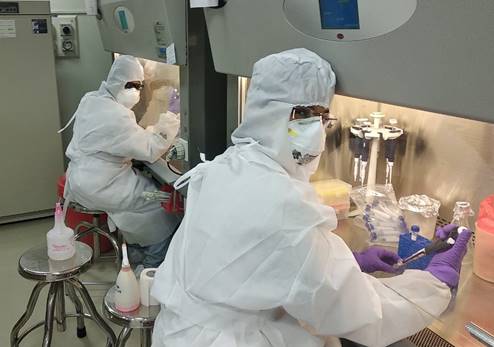
PIB News Update: The Centre for Cellular and Molecular Biology (CCMB) has established stable cultures of coronavirus (SARS-CoV-2) from patients’ samples. Virologists at CCMB have isolated infectious viruses from several isolates. The ability to culture the virus in lab enables CCMB to work towards vaccine development and testing of potential drugs to fight COVID-19.
Novel coronavirus enters human cell by binding with the ACE-2 receptor on the cell surface. Not all cells have ACE-2 receptors. Human epithelial cells in the respiratory tract copiously express ACE-2 receptors, causing respiratory disease in the infected patient. However, we cannot grow human epithelial cells in lab. “Currently, primary epithelial cells generated from human origins do not grow for many generations in labs, which is key to culturing viruses continuously. At the same time, the labs that are growing the virus need an ‘immortal’ cell line”, says Dr Krishnan H Harshan, Principal Scientist, CCMB. They use Vero cells (kidney epithelial cell lines from green African monkey), which express ACE-2 proteins and carry a cell division that allows them to proliferate indefinitely.
But why cultivate a dreadful germ? If we culture a large amount of the virus and inactivate them, then it can be used as inactivated virus vaccine. Once we inject the inactivated virus, the human immune system triggers the production of germ-specific antibodies. One can inactivate the virus by heat or chemical means. The inactivated virus can trigger antibody response, but does not infect and make us sick as they cannot reproduce.
For the development of antibodies or antidots, virus cultures are important. Inactivated viruses can trigger antibody response in other mammalian hosts in addition to humans. Various such hosts are currently under test for their efficiency of antibody response. Such antibodies generated in these non-human hosts can be purified, processed and collected. The antibodies can be used as therapeutic intervention for patients suffering from the infection. Such antibodies can trigger antiviral response upon injection into humans and have the potential of limiting the infection. Administering antibodies does not provide immunity like a vaccine does, but can be considered as anti-dotes against the virus.
These cultures may also be helpful in the process of drug screening. Potential drugs can be tested against the virus in a test-tube for their efficacy.
“Using the Vero cell lines to grow the coronavirus, CCMB is now in a position to isolate and maintain viral strains from different regions. We are working towards producing viruses in huge quantities that can be inactivated, and used in vaccine development and antibody production for therapeutic purposes”, says CCMB Director, Dr Rakesh Mishra. CCMB has also started testing potential drugs with other partners such as the Defence Research Development Organisation (DRDO) using this viral culture.
“We hope that such systems are replicated at multiple research institutes and private companies to become a useful resource in the fight against this pandemic as well as for future preparedness”, said Dr Mishra.