


PIB News Update: Indian scientists have developed a new sustainable and affordable solution for converting keratin waste such as human hair, wool, and poultry feathers to fertilizers, pet, and animal feeds. India generates a huge amount of human hair, poultry feather waste, and wool waste each year. These wastes are dumped, buried, used for landfilling, or incinerated, increasing environmental hazards, pollution, and threat to public health and increasing greenhouse gas emissions. These wastes are inexpensive sources of amino acids and protein, underlining their potential to be used as animal feed and fertilizer.
Professor A. B. Pandit, Vice-Chancellor, Institute of Chemical Technology Mumbai, along with his students, has developed a technology to covert the keratin waste to food for pets and fertilizers for plants. This novel technology is patented, easily scalable, environment-friendly, energy-efficient, and it will make amino acid-rich liquid fertilizers more economical as compared to currently marketed products.
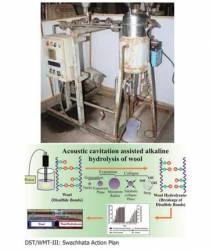
They used advanced oxidation for the conversion of the waste to marketable fertilizers and animal feed. The key technology behind this involves pre-treatment followed by hydrolysis of keratin using a technique called Hydrodynamic Cavitation, which involves vaporization, bubble generation, and bubble implosion in a flowing liquid.
The current chemicals and physical methods for such conversion are energy-intensive, chemically hazardous, and involve multiple steps resulting in a higher cost of the final product. As calculated by the team, with this technology, the cost of the product at a large-scale plant, processing inputs of 1-ton per, is up to 3 folds cheaper than the existing market product.
The scientists are currently implementing this technology at a large scale in collaboration with Revoltech Technologies Private Limited, Gujarat. This advancement in production will make the liquid biofertilizers which are three folds more efficient than the marketed product, available to farmers at an affordable rate.
For more details, contact Professor A. B. Pandit, Vice-chancellor, Institute of Chemical Technology, Matunga, Mumbai ([email protected]).
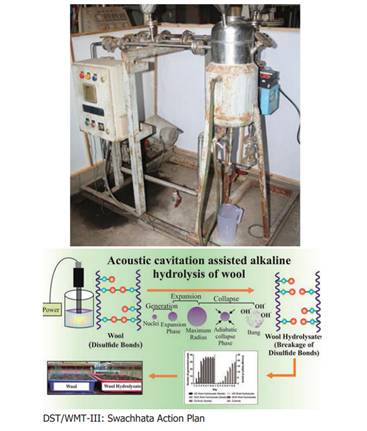
Lab-scale system
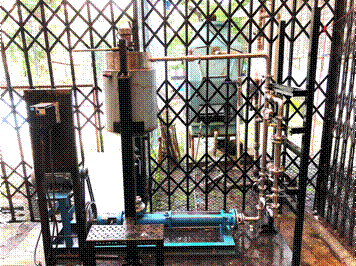
Demonstration system (50 L)