


Scientists have identified co-dopants that can increase the photovoltaic performance of transparent metal oxides such as ZnO, In2O3 and SnO2 thereby creating potential for more efficient, better performing and more stable solar cells.
In recent years solar cell technology has achieved tremendous growth as sustainable source of energy. Energy generation and storage being the need of the hour, many efforts are being made around the world to develop cost-effective options. Perovskites are a leading candidate for eventually replacing silicon as the material of choice for solar panels. Perovskite solar cell consists of a perovskite layer as the light absorber, sandwiched between the electron transport layer (ETL) coated with transparent conducting glass and hole transport layer (HTL) coated with a metal back contact electrode.
A research team from Department of Physics, Alagappa University group focused on the electron transport layer of solar cell devices which is made up of transparent metal oxides. Transparent metal oxides such as ZnO, In2O3 and SnO2 showed excellent electrical and optical properties.
The team explored the role that effective dopant can play in improving the efficiency of Tin oxide (SnO2) as an efficient transparent metal oxide for solar devices. SnO2 can be prepared at low temperatures and is relatively stable, but the functional properties such as electrical conductivity, optical transparency, and band alignment with the perovskite of the SnO2 are not sufficient to compete with commercial solar cells.
They found that while Aluminium (Al) metal when incorporated into the SnO2 lattice as a potential dopant, changes the electron concentration and series resistance of the film, addition of lanthanum (La) metal led to higher conductivity and heightened fill factor– ratio of the maximum amount of obtainable power.
In this essence, aluminium (Al) and lanthanum (La) metals were used as the suitable dopants in SnO2 and improved optical transparency, electrical conductivity, mobility, surface coverage and energy level of the SnO2. It also amplified the photovoltaic performance, reproducibility, and stability of the solar cell significantly.
SnO2 film surface coverage was enhanced by the addition of dopants Al/La which allowed modification of energy level and enhanced electron mobility, thereby improving the functional properties of SnO2 via the facile metal ions doping strategies. This study published in the Journal of Power Resources shows the benefits of codopants in increasing the photovoltaic performance, repeatability, and stability in solar devices.
Cross-sectional morphologies of Perovskite films that had been prepared were analysed utilising Field emission Scanning Electron Microscopy, while elemental and chemical characteristics were examined using X-ray photoelectron spectroscopy (XPS, Kratos AXIS Supra) supported by DST- Promotion of University Research and Scientific Excellence (PURSE). The study concluded that perovskite materials-based solar cells are cost-effective compared to commercial silicon-based solar cells.
Publication Link: https://doi.org/10.1016/j.jpowsour.2020.228443
(I) (II)
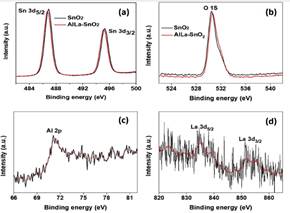
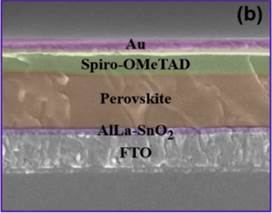
Fig. (I) XPS spectra of the SnO2 and AlLa–SnO2 films namely the (a) Sn 3d, (b) O 1s, (c) Al 2p and (d) La 3d peaks, (II) Cross-sectional SEM image of the complete AlLa–SnO2 ETL device.
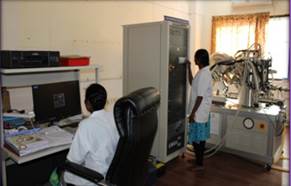

X-ray Photoelectron Spectroscopy Scanning Electron Microscope
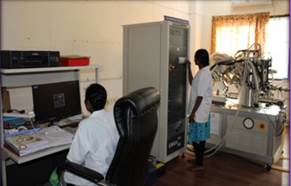
Alagappa University Students and Faculty members and external (Affiliated Colleges and various Institutions across India) researchers operate the equipment procured through PURSE funding (Dr. J. Jeyakanthan, DST-PURSE Coordinator, Alagappa University)