


A soft tunable photonic crystal with enhanced thermal stability and optical purity developed by researchers that reflects vivid colours in the visible spectrum has potential applications in making more durable and better reflective displays and laser devices.
Photonic crystals are optical nanostructures in which the refractive index changes periodically. This affects the propagation of light in the same way that the structure of natural crystals gives rise to X-ray diffraction and that the atomic lattices (crystal structure) of semiconductors affect their conductivity of electrons. Photonic crystals occur in nature in the form of structural coloration and animal reflectors. Examples found in nature include opal, butterfly wings, peacock feathers, etc., exhibiting distinct iridescent colours.
When artificially produced or engineered in laboratories, photonic crystals promise to be useful in a range of applications ranging from reflection coatings to optical computers. They enable the PCs to exhibit structural colours in the visible spectral regime. Ever since researchers have learnt how to fabricate photonic crystals, they have been on the constant lookout for tuning the properties in-situ post-fabrication. Liquid crystalline (LC) materials exhibiting self-organization, phase transition, and molecular orientation behaviors in response to external stimuli are attracting significant attention for tuning of advanced photonic materials and devices.
Blue phase (BP), a unique thermodynamic phase of liquid crystals, is a 3D photonic crystal by virtue of the combination of a cubic lattice structure and fluidity. With the lattice spacing of a few hundred nanometres, the cubic BP exhibits selective reflection of colours in the visible spectrum. Due to the soft stimuli responsiveness of BP, the Photonic Bank Gap (PBG) (phenomenon that prevents light of certain frequencies or wavelengths from propagating in one, two, or any number of polarisation directions within the materials) can be efficiently tuned with relatively low-magnitude thermal, electric and optical fields.
However, fabricating devices is still a challenge given the drawbacks BP suffers from, leading to operational difficulties. The low thermal stability and polycrystalline nature limit achieving vivid colours over a large area for device applications.
A research team from the Centre for Nano and Soft Sciences (CeNS), an autonomous institute of the Department and Science and Technology (DST), has overcome precisely these two challenges and developed a BP system which operates in the visible spectrum with high optical purity and enhanced thermal stability.
The feat is achieved by the team led by Dr. Geetha Nair by confining the BP between a pair of graphene substrates, prepared using a facile technique developed by Prof. G U Kulkarni, Director, Jawaharlal Nehru Centre For Advanced Scientific Research, Bengaluru, and his group, collaborators of this work. The non-covalent interaction between the hexagonal 2-D arrangement of carbon atoms of graphene and the liquid crystal molecules and the improved wettability helped improve the thermal stability and optical purity.
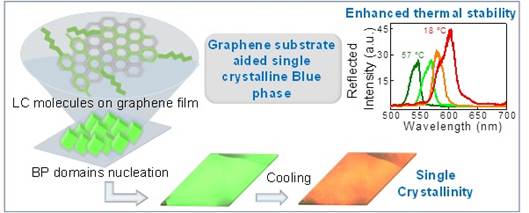
The importance of the work lies in the fact that the enhancement seen in the optical and thermal properties of BP has been achieved using an easy-to-fabricate cost-effective technique making the process highly suitable for large-scale applications. An additional dimension of tunability of colours is added by incorporating a UV-light-sensitive dye into the system. Ms. Nurjahan Khatun, the Ph.D. student who worked on the project, says, “The prototype device developed at the lab level is found to be stable at room temperatures for over six months.”