


PIB News Update: Scientists from Centre for Nano and Soft Matter Sciences (CeNS), Bengaluru an autonomous institute of the Department of Science & Technology have synthesised a series of novel photo-sensitive cholesteric liquid crystals at room temperature for widest thermal range which can be used to make optical storage devices such as optically rewritable boards, advertising boards and so on.
Liquid crystals have become an integral part of human life, for example, the most modern display devices such as computers, mobiles, TV screens, and so on are made up of liquid crystals. Cholesteric liquid crystals are special kind of materials which have the property of reflecting the light of wavelength equal to its pitch length, and this pitch length is temperature-sensitive. So, they are generally used as thermal sensors. If such cholesteric liquid crystals are made photo-sensitive, then these materials can be used for optical storage devices and other related applications.
The team of scientists from CeNS headed by Dr Veena Prasad have synthesised these novel photo-sensitive cholesteric liquid crystals for temperature range from -10oC to 160oC. Hence, the devices made using these liquid crystals can be used in Syberia to Saudi Arabia where extreme temperatures were reported. A simple, cost-effective procedure was adopted to synthesise such materials. These room-temperature liquid crystals can be used for creating optical storage devices, liquid crystal displays and so on.
The phenomena driving such optical storage device lies in tuning the molecules with light. Energetically more stable trans-state of azobenzene based photosensitive molecules turned to metastable cis configuration with the illumination of suitable UV light. Bringing them back to the original trans-state can be done using either by shining light of higher wavelength (~ 450nm) or by keeping it in a dark state. The later process is known as thermal back relaxation, where only room temperature is playing the role. The idea behind the phenomena is to increase such thermal back relaxation to retain the optically written images for a long time.
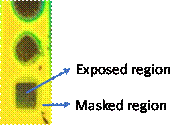
An optical storage device based on above phenomena was fabricated, in collaboration with Dr Gurumurthy Hegde from BSN Centre for Nano-materials and Displays, BMS College of Engineering, Bengaluru, using one of these materials. The device has shown very high thermal back relaxation with good contrast between the illuminated region (dark state) and masked region (bright state). This process took almost 5 hours to relax back to its original configuration (i.e., trans-state). Such devices are extremely useful in creating rewritable advertisement boards where one can store the images for several hours and then can be rewritten or in some cases can be kept as permanent storage device. Then can also be used as optical rewritable boards for schools and colleges.
This invention will definitely help to bring down the cost of the devices with a very simple yet powerful photoisomerisation concept. An Indian patent has been filed for this invention.
Figure: High contrast images with masked regions (bright in colour) and dark regions (exposed regions) showing good contrast between bright and dark states. The image took almost 5 hours to relax to its original state.
[For further details, contact Dr Veena Prasad ([email protected]).]