


PIB News Update:In India, close to twenty-three million tonnes of leftover rice residues are annually burnt by farmers to get rid of the straw and prepare their fields for sowing wheat, which is the next crop, resulting in air pollution. Also, dry environments pose a challenge for the germination of wheat varieties with short coleoptile.
To overcome these problems, Scientists at Pune based Agharkar Research Institute (ARI), an autonomous institute of the Department of Science and Technology, have mapped two alternative dwarfing genes Rht14 and Rht18 in wheat. These genes are associated with better seedling vigour and longer coleoptiles (sheath protecting the young shoot tip).
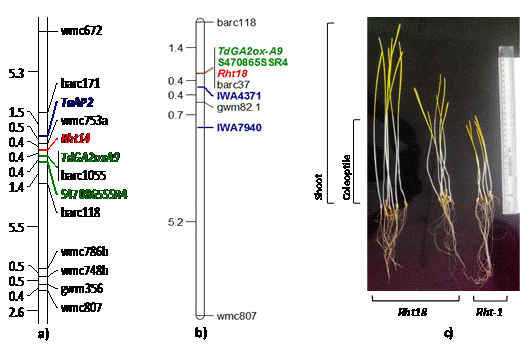
The lead Scientist Dr. Ravindra Patil along with his team from Genetics and Plant Breeding Group, ARI have mapped the dwarfing genes on chromosome 6A in durum wheat, and DNA-based markers were developed for a better selection of these genes in wheat breeding lines. The DNA-based markers will help wheat breeders to precisely select wheat lines carrying these alternative dwarfing genes from a massive pool of wheat breeding lines. The research was published in The Crop Journal and Molecular Breeding.
These DNA based markers are being used at ARI for marker-assisted transfer of these genes in Indian wheat varieties, so as to make them suitable for sowing under rice stubble-retained conditions and dry environments. Wheat breeding lines with these alternative dwarfing genes are presently at an advanced stage.Wheat lines with these alternative dwarfing genes, apart from reducing crop residue burning, can allow deeper sowing of wheat seeds to avail advantage of residual moisture in the soil under dry environments.
The presently available semi-dwarf wheat varieties, which were explored during the Green Revolution, carry conventional Rht1 dwarfing alleles (variant form of a given gene) and produce optimum yields under high-fertility irrigated conditions. However, they are not well adapted for deeper sowing conditions in dry environments due to shorter coleoptiles, and low early vigor often results into reduced seedling emergence. Moreover, crop stands of Rht1 wheat also remain poor where previous crop residues pose a barrier for seedling emergence due to the short coleoptiles.
Burning of leftover rice crop residue has serious implications for the environment, soil, and human health. Therefore, there is a need to include alternative dwarfing genes in wheat improvement programs. Also, only two dwarfing alleles of Rht1 are predominant in Indian wheat varieties; therefore, there is a need to diversify the genetic base of dwarfing genes considering diverse wheat growing zones in India.
In genetic studies conducted at ARI, dwarfing genes Rht14 and Rht18 in wheat conferred a plant height reduction comparable to the Rht1 alleles while retaining early vigour in wheat seedlings, but do not affect coleoptile length and seedling shoot length. These can, therefore, be utilized as an alternative dwarfing gene to Rht1 for deep sowing conditions or in fields with retained stubble.
The improved wheat lines which are being developed at ARI will help reducing stubble burning incidences under the rice-wheat cropping system. These lines will also allow deeper sowing of wheat seeds to avail advantage of residual moisture in the soil, therefore, saving valuable water resources and reduce the cost of cultivation to farmers.
For more details contact Dr. Ravindra Patil ([email protected], 020-25325093), Scientist, Genetics and Plant Breeding Group, and Dr. PK Dhakephalkar, Director (Officiating), ARI, Pune, ([email protected], [email protected], 020-25325002)
Figure description: a & b) Alternative dwarfing genes Rht14 and Rht18 mapped on chromosome 6A in wheat. DNA-based markers developed at ARI Pune, shown in green, are being used for marker-assisted introgression of these genes in elite Indian wheat varieties to improve seedling emergence. c) Rht18 introgression lines showing improved coleoptile length and seedling shoot length.
[Publication links:
Vikhe et al. 2019, The Crop Journal, 7: 187-197
https://doi.org/10.1016/j.cj.2018.11.004
Vikhe et al. 2017, Molecular Breeding, 37: 28
DOI: 10.1007/s11032-017-0641-9]