


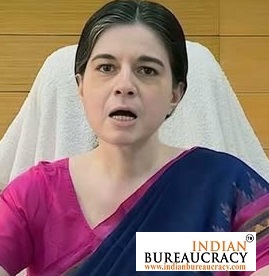
Indian Bureaucracy News, New Delhi, December 11, 2025 | The Center has appointed senior bureaucrat, Smt Shalini Pandit, 2001-batch IAS officer of the Odisha cadre, as a Part-time Member of the Insurance Regulatory and Development Authority of India (IRDAI), with immediate effect, succeeding Shri Parshant Kumar Goyal. The notification (dt 03.12.2025) was issued by the Department of Financial Services, Ministry of Finance.
Smt Pandit, currently Joint Secretary in the Department of Financial Services (DFS), assumed central deputation on 13th September 2025. Prior to this, she served as Commissioner‑cum‑Secretary, School & Mass Education Department, Government of Odisha, Bhubaneswar. She holds a Graduate degree in Botany from Miranda House, University of Delhi (First Division), an M.Sc. in Wildlife Management from Saurashtra University and the Wildlife Institute of India (First with Distinction), and a postgraduate degree in Wildlife Management — a rare specialisation among senior civil servants
IRDAI: From Background Regulator to High-Profile Watchdog
Created under the IRDA Act, 1999, the Authority oversees insurers and intermediaries in life, health, motor and general insurance. Long viewed as a quiet but essential regulator, IRDAI has stepped into sharper public focus in recent months, driven by Supreme Court scrutiny, sector-wide reforms and stricter enforcement. The insurance industry, once a largely silent corner of India’s financial architecture, is now experiencing an active phase of regulatory change.
In October 2025, the Supreme Court directed IRDAI and major insurers to standardise motor insurance policies. The Court highlighted that more than half of India’s vehicles remain uninsured, and inconsistent policy terms across insurers often confuse consumers and prolong litigation. IRDAI was tasked with harmonizing policy provisions and expanding public awareness to improve coverage compliance.
Later, in November, the government and IRDAI unveiled reforms to the insurance ombudsman framework. These include an online complaint registration system, stricter penalties for non-compliance by insurers, removal of compensation caps, and the establishment of internal ombudsmen within companies to resolve claims up to ₹50 lakh. These measures aim to accelerate grievance resolution and enhance accountability in the sector.
IRDAI has also intensified regulatory enforcement. Panels of whole-time members examine violations of norms by insurers and intermediaries, while penalties have been imposed for improper payments and compliance breaches. These steps signal a more assertive regulatory stance, ensuring market conduct aligns with policyholder interests.
On a broader front, IRDAI has initiated a high-level review of the Insurance Act, 1938, under the guidance of a committee led by former SBI chairman Dinesh Khara. Discussions include potential simplification of regulatory processes and easing restrictions on foreign investment, aiming to expand market access and deepen penetration.
Despite these measures, challenges persist. Consumer confidence is tested by disputed claims, such as cases where insurers tried to deny payouts due to a treating doctor being a relative. Policyholders also face sophisticated cyber frauds impersonating IRDAI officials, underscoring the ongoing need for vigilance and public awareness.
The insurance sector, long seen as a silent pillar of India’s financial ecosystem, is now witnessing regulatory evolution, with IRDAI at the center. Ms. Pandit’s presence on the board reflects both continuity and capability, combining administrative experience with an uncommon academic profile, ready to navigate the challenges of a complex, rapidly growing market.
IndianBureaucracy.com wishes Smt Shalini Pandit the very best.