


PIB News Update: Gold has been a fascinating metal for use in jewelry and well as industrial applications because of its high resistance against conventional oxidizing environments. The unique property of Au is mainly dictated by its atomic arrangement in the crystal structure, technically called face-centered cubic (fcc) lattice.
Scientists have introduced new catalytic properties in gold by altering the most stable fcc lattice, converting it into a new avatar that can trigger gold-based catalysis for industry.
Tuning of crystal structures and shapes of micro-sized noble metals or micro-crystallites have revealed fascinating catalytic, optical, electrical, and magnetic properties that enable developments of environmentally friendly and durable nano-technological applications.
Scientists from Jawaharlal Nehru Centre for Advanced Scientific Research (JNCASR), an autonomous institute of the Department of Science & Technology (DST), Government of India, have stabilized gold in non-cubic lattice, unfurling efficient catalytic properties of the metal.
The team guided by Prof. G.U Kulkarni from JNCASR has stabilized Au in mixed lattices consisting of lower symmetry lattices in the form of micro-crystallites, induced by geometrical constraints. In contrast to conventional bulk fcc gold, these micro-crystallites are more efficient in their catalytic activity. Besides, the crystallites behave nobler than the conventional fcc Au in mercury and aqua regia. Thus, these Au crystallites behave quite differently from our day to day used ones, and the credit goes to the underlying unconventional lattices.
This research published in the journal ACS Nano’wassupported by the Department of Science & Technology, Government of India (DST) provided within the framework of the India@Desy collaboration and Nano Mission and the technical support from the EU-Horizon2020 research and innovation program of Nanoscience Foundries and Fine Analysis (NFFA).
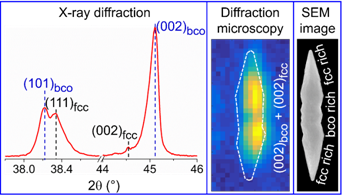
In this work, JNCASR team joined by Prof. M.K Sanyal from SINP, Kolkata used scanning X-ray diffraction microscopy (SXDM) technique with nano-beam at DeutschesElektronen-Synchrotron(DESY), PETRA III, Germany, which revealed location of the spatial distribution of the different lattices in the crystallite volume without using any slicing techniques.
Correlation between X-ray diffraction, diffraction microscopy and the corresponding multi-phased diffracting volumes in the crystallite
The study disclosed many surprises. The central part of the crystallite is rich in lower symmetry lattices while being capped by the fcc rich tips, which explains their unique behavior in aqua regia. Besides, co-presence of compression and expansion to the extent of approximately 5% (compared with conventional fcc Au) in the micrometer-sized crystallite helps the crystallites remain ambient stable for years. Such study of the spatial distribution of the different phases can allow exploration of new properties in a much better way.
[Publication link:https://doi.org/10.1021/acsnano.0c02031
For more details co-author of this research work Miss Chaitali Sow (Ph.D. student, JNCASR): [email protected] can be contacted.]