



PIB News Update: Scientists have developed a gold microstructure substrate with the ability to repel water as well as bubbles with tunable wettability, which can be used in designing microfluidic devices, biosensors and useful in water transportation and self-cleaning.
Wettability, or the ability of a liquid to maintain contact with a solid surface, is an important property in surface and interface science. Its influence is seen in many biochemical processes, sensing, microfluidics, water transportation, self-cleaning, industrial processes. The tunable wettability results from tunability in surface energy of the substrate, which can be utilized to regulate the direction of flow in water transportation and self-cleaning applications.
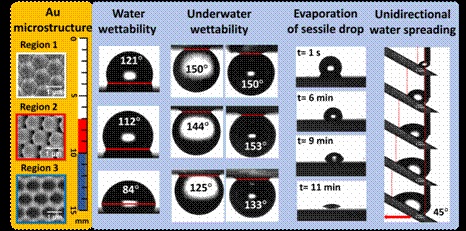
According to the recent work published in ‘Journal of Applied Physics’, Dr. P. Viswanath and his group from the Centre for Nano and Soft Matter Sciences (CeNS), an autonomous institute of the Department of Science and Technology (DST), have developed a substrate exhibiting morphological gradient that helps one to tune the wettability because of surface energy change. The morphological gradient in the substrate ranges from domes to elliptical holes.
Water and oil wetting studies at each position on the substrate revealed that wetting is tunable with morphology. The substrate showed hydrophobic nature, which gets magnified when coated with a self-assembled monolayer of octadecane thiol – a water-soluble sulfur compound with a carbon alkyl chain. The coating results in a reduction in surface energy, which in turn facilitates an enhancement in hydrophobic behaviour.
Underwater wettability investigations on the substrate showed that it mainly repelled bubbles and when functionalised with coating of octadecanethiol, it repels mainly oil. Ms. Brindhu Malani S, a research scholar working on this, pointed out that these studies would be useful in designing microfluidic devices, biosensors, and water transportation.
[Publication link: https://doi.org/10.1063/5.0017763
For more details, contact Dr. P. Viswanath (Email: [email protected]).]