


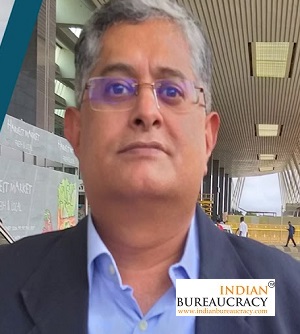
Ramesh Krishnamurthi IRS upgraded as Special Secretary (rank & pay of Secretary)
Shri Ramesh Krishnamurthi IRS (IT 1992) presently Central Provident Fund Commissioner, Employees’ Provident Fund Organization has been appointed as Central Provident Fund Commissioner, Employees’ Provident Fund Organization (in-situ upgradation as Special Secretary in the rank and pay of Secretary to the Government of India).
The Employees’ Provident Fund Organisation (EPFO) is one of India’s largest and most significant social security institutions, playing a crucial role in providing financial protection to salaried employees in the organised sector. Functioning under the Ministry of Labour and Employment, Government of India, EPFO administers retirement-related benefits for millions of workers across the country. As part of India’s broader administrative ecosystem, the organisation represents an important pillar of the Indian Bureaucracy, ensuring long-term income security and welfare for employees and their families.
Established in 1952 under the Employees’ Provident Funds and Miscellaneous Provisions Act, EPFO has evolved into a massive statutory body managing one of the world’s largest social security funds. Its mandate extends beyond provident fund savings to include pension and insurance benefits, making it a comprehensive social protection institution.
Structure and Governance of EPFO
The EPFO operates through a tripartite structure that includes representatives from the government, employers, and employees. At the apex level is the Central Board of Trustees (CBT), chaired by the Union Minister for Labour and Employment. The CBT is responsible for policy decisions, investment strategies, and overall governance of the organisation.
Administratively, EPFO is headed by the Central Provident Fund Commissioner (CPFC), supported by Additional, Deputy, and Regional Provident Fund Commissioners. The organisation has a wide network of regional, zonal, and sub-regional offices across India, enabling decentralised service delivery. This administrative setup reflects the broader governance framework regularly highlighted in Indian Bureaucracy Latest News and related policy discussions.
Core Schemes Administered by EPFO
EPFO manages three major statutory schemes that together form the backbone of employee social security in India:
-
Employees’ Provident Fund (EPF) Scheme, 1952
This is a mandatory savings scheme for employees earning wages up to the prescribed ceiling. Both employer and employee contribute a fixed percentage of wages each month. The accumulated corpus earns interest and can be withdrawn at retirement or under specified conditions. -
Employees’ Pension Scheme (EPS), 1995
EPS provides monthly pension benefits to employees after retirement, as well as pensionary support to widows, children, and nominees in case of death of the member. -
Employees’ Deposit Linked Insurance (EDLI) Scheme, 1976
This scheme offers life insurance coverage to EPF members without requiring any additional contribution from employees.
Together, these schemes ensure financial stability during retirement, disability, or unforeseen circumstances.
Digital Transformation and Service Delivery
Over the past decade, EPFO has undergone significant digital transformation aimed at improving transparency, efficiency, and ease of access. Initiatives such as the Universal Account Number (UAN) have enabled portability of accounts across employers, allowing seamless transfer of provident fund balances.
Online facilities now allow members to view passbooks, submit claims, update KYC details, and track claim status digitally. Integration with Aadhaar, PAN, and banking systems has further streamlined processes and reduced delays. These reforms align with broader administrative modernization trends often featured under Top Indian Bureaucracy News and governance reform discussions.
Role in Economic and Social Stability
EPFO plays a critical role in India’s socio-economic framework by encouraging long-term savings and financial discipline among the workforce. The organisation manages a massive corpus, investing funds through approved investment patterns that balance safety, returns, and liquidity. Its investment decisions have a meaningful impact on capital markets and long-term infrastructure financing.
During periods of economic stress, such as the COVID-19 pandemic, EPFO introduced special withdrawal provisions and relaxed norms to provide immediate financial relief to members. These measures highlighted its role as a responsive and people-centric institution.
Challenges and Ongoing Reforms
Despite its scale and reach, EPFO faces challenges related to grievance redressal, legacy data management, employer compliance, and service consistency across regions. Continuous reforms focus on strengthening digital infrastructure, improving turnaround time for claims, and enhancing transparency.
The organisation is also adapting to changes in the labour market, including the growth of contractual employment and platform-based work. Policy discussions around extending social security coverage to unorganised and gig workers are increasingly shaping the future roadmap of EPFO.
The Employees’ Provident Fund Organisation remains a cornerstone of India’s social security architecture, safeguarding the financial future of millions of employees. Through structured governance, expanding digital services, and ongoing reforms, EPFO continues to evolve in line with the country’s economic and administrative priorities. Developments related to EPFO and allied institutions are regularly tracked under Latest Indian Bureaucracy News and referenced by platforms such as indianbureaucracy.com, which document key policy shifts, administrative reforms, and governance trends across India.
Indian Bureaucracy News wishes Shri Ramesh Krishnamurthi the very best.