


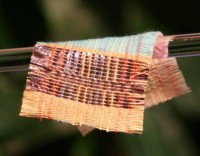
Summary:Fabrics that can generate electricity from physical movement have been in the works for a few years. Now researchers have taken the next step, developing a fabric that can simultaneously harvest energy from both sunshine and motion.
Fabrics that can generate electricity from physical movement have been in the works for a few years. Now researchers at Georgia Institute of Technology have taken the next step, developing a fabric that can simultaneously harvest energy from both sunshine and motion.
Combining two types of electricity generation into one textile paves the way for developing garments that could provide their own source of energy to power devices such as smart phones or global positioning systems.
“This hybrid power textile presents a novel solution to charging devices in the field from something as simple as the wind blowing on a sunny day,” said Zhong Lin Wang, a Regents professor in the Georgia Tech School of Materials Science and Engineering.
The research was reported September 12 in the Nature Energy.
To make the fabric, Wang’s team used a commercial textile machine to weave together solar cells constructed from lightweight polymer fibers with fiber-based triboelectric nanogenerators.
Triboelectric nanogenerators use a combination of the triboelectric effect and electrostatic induction to generate small amount of electrical power from mechanical motion such as rotation, sliding or vibration.
Wang envisions that the new fabric, which is 320 micrometers thick woven together with strands of wool, could be integrated into tents, curtains or wearable garments.
“The fabric is highly flexible, breathable, light weight and adaptable to a range of uses,” Wang said.
Fiber-based triboelectric nanogenerators capture the energy created when certain materials become electrically charged after they come into moving contact with a different material. For the sunlight-harvesting part of the fabric, Wang’s team used photoanodes made in a wire-shaped fashion that could be woven together with other fibers.
“The backbone of the textile is made of commonly-used polymer materials that are inexpensive to make and environmentally friendly,” Wang said. “The electrodes are also made through a low cost process, which makes it possible to use large-scale manufacturing.”
In one of their experiments, Wang’s team used a fabric only about the size of a sheet of office paper and attached it to rod like a small colorful flag. Rolling down the windows in a car and letting the flag blow in the wind, the researchers were able to generate significant power from a moving car on a cloudy day. The researchers also measured the output by a 4 by 5 centimeter piece, which charged up a 2 mF commercial capacitor to 2 volts in one minute under sunlight and movement.
“That indicates it has a decent capability of working even in a harsh environment,” Wang said.
While early tests indicate the fabric can withstand repeated and rigorous use, researches will be looking into its long-term durability. Next steps also include further optimizing the fabric for industrial uses, including developing proper encapsulation to protect the electrical components from rain and moisture.
More:Science