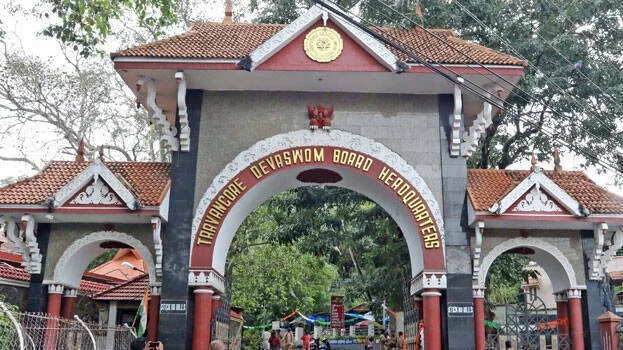
Indian Bureaucracy News, Thiruvananthapuram, December 06, 2025 | In Kerala, a legal challenge filed this week has drawn renewed attention to the Travancore Devaswom Board (TDB), the autonomous body that oversees more than a thousand temples including Sabarimala, one of the state’s most sensitive religious institutions.
Ashok B IAS KL
Senior IAS officer Dr B Ashok (Kerala 1998), has approached the Thiruvananthapuram District Court seeking the disqualification of retired bureaucrat K Jayakumar from his position as TDB President. The petition brings into sharp focus long-standing debates over the autonomy of the Board, the boundaries of post-retirement appointments, and the relationship between the state government and temple administration.
Shri K Jayakumar IAS (Retd.), a former Additional Chief Secretary and a respected cultural figure in Kerala, was appointed President of the TDB on November 14, 2025 and sworn in the following day. He was chosen in part because of his longstanding association with the administration of Sabarimala, where he previously served as Devaswom Secretary, Chief Devaswom Commissioner, and chairperson of the High Court–appointed high-powered committee on Sabarimala.
K Jayakumar IAS (Retd) Kerala
His appointment came at a delicate moment, the Sabarimala temple administration was still grappling with the fallout of a gold theft controversy, and the government had been under pressure to restore transparency and confidence in temple affairs. Against this backdrop, Ashok’s petition argues that the state may have erred in selecting a candidate whose eligibility he says is barred by statute.
At the core of the petition is Section 7(iii) of the Travancore-Cochin Hindu Religious Institutions Act, which prohibits individuals holding any salaried office under the government from serving on the Board. Ashok contends that Jayakumar continues to occupy such a role as Director of the Institute of Management in Government, a position he has held since 2018. The plea describes the post as an office of profit, alleging a clear master-servant relationship with the government and arguing that the law’s bar applies regardless of whether the TDB role itself is salaried. The petition also cites age restrictions contained in the Act—Jayakumar is 73, well beyond the upper limit of 60—and alleges that this marks at least his third irregular post-retirement appointment, following a stint as Vice-Chancellor of the Malayalam University in 2012. These factors, Ashok says, undermine both the credibility and independence of the Board, which is tasked with safeguarding the interests of Hindu temples and their devotees.
The court has admitted the petition and issued notices to the respondents. Hearings are scheduled to begin on January 15, 2026, setting the stage for a potentially consequential debate over the legal framework governing one of Kerala’s oldest religious institutions. Jayakumar has said the challenge is misplaced, arguing that no dual compensation is involved, that his role with the TDB is temporary and unpaid, and that the IMG is an autonomous entity that does not rely on state funding in a manner that would classify it as a salaried government post. In his view, the petition is less a personal challenge and more a dispute directed at the state government’s interpretation of the law.
Chief Minister Pinarayi Vijayan has defended the appointment, describing Jayakumar as a retired civil servant who is no longer bound by the constraints applicable to serving officers. He has also sought to downplay concerns over the legitimacy of the process, pointing to broad acceptance among Ayyappa devotees and Board members. The Chief Minister has cast the petition as unnecessary, though it does highlights the political sensitivities surrounding the institution at a time when public scrutiny of temple governance is unusually high.
The controversy arrives against a long historical arc. The Travancore Devaswom Board traces its origins to early nineteenth-century efforts to curb mismanagement in temple endowments, when the rulers of Travancore assumed stewardship of hundreds of temples amid widespread concerns over fraudulent practices. By 1950, following the integration of the princely states into the Indian Union, the Travancore-Cochin Hindu Religious Institutions Act formally established the Board as an autonomous body, insulated from direct executive control and governed by a President and two members selected through a mix of political nomination and legislative election. Its mandate—temple maintenance, property administration, ritual oversight, and pilgrim welfare—has expanded over the decades, but the idea of autonomy from partisan influence has remained central to its legitimacy.
Today, the Board finds itself navigating modern pressures, demands for transparency, the scale of Sabarimala’s seasonal pilgrim inflows, and periodic allegations of administrative lapses. The dispute over Jayakumar’s appointment now adds a legal dimension to these challenges. Whatever the court ultimately rules, the petition has reopened a broader conversation about how the state balances respect for religious institutions with the need for administrative competence, and how far governments should go in selecting familiar public figures for sensitive posts. It is a conversation likely to continue well beyond the January hearing, as Kerala contemplates the future of one of its most historic and closely watched public bodies.