


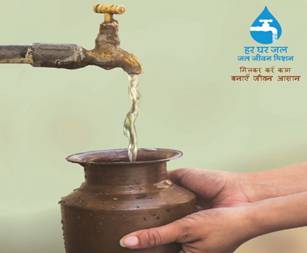
Minister of State for Jal Shakti, Shri Prahlad Singh Patel has informed that Since August, 2019, Government of India in partnership with States is implementing Jal Jeevan Mission (JJM) to make provision of potable tap water supply to every rural household of the country by 2024.
At the time of announcement of Jal Jeevan Mission, 11.74 lakh (11.11%) rural households in the State of Rajasthan were reported to have tap water connections. As reported, 12.39 lakh (11.72%) rural households have been provided with tap water connections in last two and half years. Thus, as of date, out of 105.69 lakh rural households in Rajasthan, 24.13 lakh (22.83%) households are reported to have tap water supply in their homes.
Jal Jeevan Mission is being implemented as a decentralized, demand-driven and community-managed programme, wherein the Gram Panchayat and/ or its sub-committee/ user group i.e. Village Water & Sanitation Committee (VWSC)/ Pani Samiti are being empowered to plan, implement, manage, operate and maintain in-village water supply system to provide regular and assured tap water supply in rural households.
The water sources inter alia which include groundwater (open well, borewell, tube well, handpumps, etc.), ancient & traditional surface water (river, reservoir, lake, pond, springs, etc.) and rain water stored in small tanks are being used as sources for drinking water supply schemes. As such details of individual projects/ schemes for rural water supply projects including water source for scheme are not maintained at the Government of India level.
Under JJM, provisions have been made for drinking water source development/ strengthening/ augmentation; and infrastructure for bulk transfer of water, treatment and distribution systems in water deficit drought-prone and desert areas without dependable ground water sources, apart from creation of in-village water supply infrastructure.
In addition, provisions for taking up augmentation and strengthening of local & ancient drinking water sources in convergence with other schemes at village level viz. MGNREGS, 15th Finance Commission tied grants to Rural Local Bodies (RLBs), Integrated Watershed Management Programme (IWMP), State schemes, District Mineral Development Fund, CSR funds, community contribution, etc. have also been envisaged under the JJM.
Further, important measures taken by the Central Government for conservation, management of ground water and effective implementation of rain water harvesting in the country are available in public domain at:
http://jalshakti-dowr.gov.in/sites/default/files/Steps_to_control_water_depletion_Feb2021.pdf
As per existing guidelines, BIS 10500 is to be adopted for ensuring safe drinking water supply and States/ UTs have been advised to carry out testing of drinking water sources once in year for chemical and physical parameters and twice in a year for bacteriological parameters. To enable States/ UTs to test water samples for water quality, and for sample collection, reporting, monitoring and surveillance of drinking water sources, an online JJM – Water Quality Management Information System (WQMIS) portal has been developed. The State–wise details of water quality test reported through WQMIS is available in public domain on JJM Dashboard and can also be accessed at:
https://neer.icmr.org.in/website/main.php
This portal also provides automated alerts to concerned authorities in States/ UTs, if the watersample tested is contaminated, to initiate remedial actions. States/ UTs have also beenadvised to identify and train 5 persons preferably women in each village viz. ASHA workers,health workers, VWSC members, teachers, etc. to conduct water quality tests using FTKs/bacteriological vials at village level and report the same on the portal.
Further, to encourage water quality testing to ensure potable drinking water supply, States/ UTs havebeen advised to open water quality testing laboratories to general public at a nominal rate fortesting of their water samples.
Under JJM, upto 2% of the allocation to States/ UTs can be utilized for Water Quality Monitoring & Surveillance (WQM&S) activities inter alia which includes activities like setting up and strengthening of water quality testing laboratories, procurement of equipment, instruments, chemicals, glassware, consumables, hiring of skilled manpower, surveillance by community using field test kits(FTKs), awareness generation, educational programmes on water quality, NABL accreditation/ recognition of laboratories, etc.