


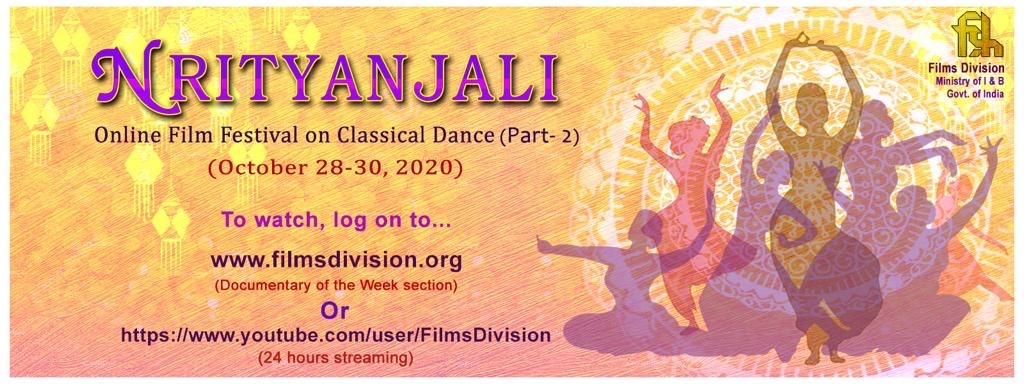
PIB News Update: After the overwhelming response to the first part of Nrityanjali, an online festival of documentary films on the life and work of some of the leading Indian classical dance exponents, Films Division is presenting the concluding part of the festival where well-researched documentaries on the distinct styles, depth and nuances of some of the ancient and popular classical dances will be screened on FD website and YouTube channel between October 28–30, 2020.
The Nrityanjali – Part II begins with the screening of Aum Namah Shivay (27 Mins / 1981/ Loksen Lalvani). The film is about Parvati, the Goddess of dance and daughter of the Himalayas and the consort of Shiva-Nataraja who brought the dance to the Earth. Various manifestations of dance are found in India from the Himalayas in the north top to Kanyakumari in the south bottom.While wandering, she interacts with the sculpted myths by her devotion and offers her prayers to the Gods in the form of sacred Indian classical dances.
Kathakali (22 Min / 1959 / Mohan N Wadhwani) is an early filmic description of the unique classical dance drama of Kerala and shows the self discipline required for learning Kathakali. The documentary also shows the schools were this ancient dance form is taught to pupils and the various characters made up for the performance.
Odissi Dance (21 Mins / 1972 / Ghanashyam Mohapatra) is on the famous classical dance, “Odissi”, originated in Orissa many centuries ago, to become most popular throughout the country and abroad.
Kuchipudi Dance: Ancient & Modern (Part –I) (21 Mins / 1973 / T.A. Abraham) & Part –II (16 Mins).The first part of the film briefly traces the tradition of this popular dance form and the second part presents ‘Bhama Kalapam’, a homage to Lord Krishna.
The Thinking Body (81 Mins / 2016 / Kadambari Shivaya). Dance is the state of being that transcends one’s physical self, delving into deep states of resonating minds in a spectrum of timelessness, of time-past, time-present and time-future. The Thinking Body interprets the mind of the character it portrays through spiritual layers. Indian Classical dance forms provide a perfect vehicle for interactions of varied emotions and rasas in perfect harmony, irrespective of time, space and gender.
Kathak (22 Mins / 1970 / S. Sukhdev). One of the popular classical dance forms originated from India, Kathak traces its origins to the nomadic bards of ancient northern India, known as Kathakars or storytellers. Its form today contains traces of temple and ritual dances, and the influence of the bhakti movement. From the 16th century onwards it absorbed certain features of Persian dance and central Asian dance which were imported by the royal courts of the Mughal era. This film dwells on the history of Kathak dance.
The documentaries will be streamed simultaneously on www.filmsdivision.org/Documentary of the Week and https://www.youtube.com/user/FilmsDivision for three days, from 28th to 30th October, 2020.