


Summary:Nitrogen is essential for all life on Earth. In the global oceans however, this element is scarce, and nitrogen availability is therefore critical for the growth of marine life. Some bacteria found in marine waters can convert nitrogen gas (N2) to ammonia (known as N2 fixation), and thereby supply the marine food web with nitrogen.
Nitrogen is essential for all life on Earth. In the global oceans however, this element is scarce, and nitrogen availability is therefore critical for the growth of marine life. Some bacteria found in marine waters can convert nitrogen gas (N2) to ammonia (known as N2 fixation), and thereby supply the marine food web with nitrogen.
How on Earth?
It has puzzled scientists for years whether and how bacteria, that live from dissolved organic matter in marine waters, can carry out N2 fixation. It was assumed that the high levels of oxygen combined with the low amount of dissolved organic matter in the marine water column would prevent the anaerobic and energy consuming N2 fixation.
Already in the 1980s it was suggested that aggregates, so-called “marine snow particles,” could possibly be suitable sites for N2 fixation, but this was never proven.
Until now..
In a new study, researchers from the University of Copenhagen demonstrate, by use of mathematical models, that microbial fixation of nitrogen can take place on these aggregates of live and dead organisms in the marine plankton. The study has just been published in the journal Nature Communications.
Marine snow
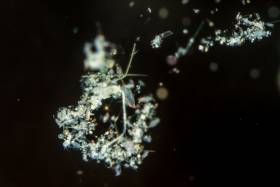
Marine snow consists of debris from diverse organisms in the water column.
Picture shows marine snow from the Sargasso Sea. Photo: L. Riemann
“Our work took almost two years, but it was definitely worth the effort, since the results are quite a breakthrough. In close collaboration with our research collaborators at the Center for Ocean Life at DTU Aqua and in the USA, we managed to create a model mimicking conditions on marine snow particles. With this model, we show that a marine particle can become densely colonized by bacteria. This growth of bacteria causes extensive respiration leading to low oxygen concentrations on the particle, which ultimately allows for the anaerobic process of N2 fixation,” explains first-author and postdoc at the Department of Biology, University of Copenhagen, Subhendu Chakraborty.
With their model the researchers could also show the depth distribution of N2 fixation in the marine water column. They found, that among other things, the N2 fixation is dependent on the size, density and sinking speed of the marine snow particles. Moreover, they demonstrated that their modelled rates were comparable to actual rates measured in marine waters.
Marine water sampler
Marine water samples are often taken with bottles attached to a so-called rosette, as seen here. Photo: L.asse Riemann
“This comparison gave us confidence in the model,” says corresponding author Lasse Riemann, Professor at the Department of Biology. He continues: “We are very proud of our study, because it provides the first explanation of how marine-snow-associated N2 fixation can take place. Furthermore, the results indicate that this process is important for the global marine nitrogen cycling and thereby for plankton growth and productivity.”
The researchers hope their study will inspire future work on microbial life on marine particles, due to its seemingly pivotal role in the cycling of many nutrients in the ocean.
More: Science Daily