


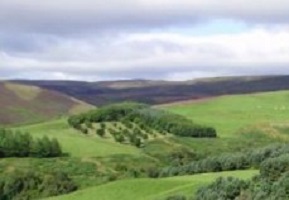
Summary:Planting trees can reduce flood risk, but a high intensity forest land use, such as grazing, can counteract the positive effect of the trees, a recently published study suggests. The study investigated the rate that water infiltrated the soil under trees at an experimental agroforestry site in Scotland.
Planting trees can reduce flood risk, but a high intensity forest land use, such as grazing, can counteract the positive effect of the trees, a recently published study suggests.
As the frequency and severity of flooding becomes an increasing problem, land managers are turning to natural flood management measures, such as tree planting, to reduce the risk.
When rainfall exceeds the rate at which water can enter the soil it flows rapidly over the land’s surface into streams and rivers. Trees can help to reduce the risk of surface runoff by increasing the number of large pores in the soil through which water can drain more easily. Land use, such as grazing, also affects the soil’s ability to absorb water; however, while the effect of land use on surface runoff has been well studied in grasslands, little is known about the effect of land use in forests.
The study, undertaken by Lancaster University and the Centre for Ecology and Hydrology and published in the journal Geoderma, investigated the rate that water infiltrated the soil under trees at an experimental agroforestry site in Scotland.
Researchers found that infiltration rates were between ten and a hundred times higher under trees, when the forested area remained relatively undisturbed, compared with adjacent pasture. Where sheep were allowed to graze under the trees there was no observable difference from the pasture.
They also compared forest types — conifer forest planted with Scots Pine and broadleaved forest planted with sycamore — and found that infiltration rates were significantly higher under Scots Pine than under sycamore, but only when the forest was ungrazed.
Using rainfall records the researchers were able to infer that a storm with a probability of occurring at least every 2 years would be very likely to generate surface runoff in the grazed forest at the field site. However, it was unlikely to occur in the undisturbed forest areas, regardless of tree species, even during a 1 in 50 year storm.
Lead author Dr Kathy Chandler said, “Previous studies have often compared largely undisturbed forested areas with land that is grazed or used to grow crops. This has led to the perception that trees always increase infiltration rates and, therefore, reduce the risk of surface runoff; however, this study shows that forest land use also plays an important role.”
“Tree planting can make an important contribution to flood risk management, but forest buffer zones, with restricted access, strategically placed to intercept surface runoff before it reaches the stream may be more effective than larger scale planting when the forested areas are used for other purposes.”
More:ScienceDaily