


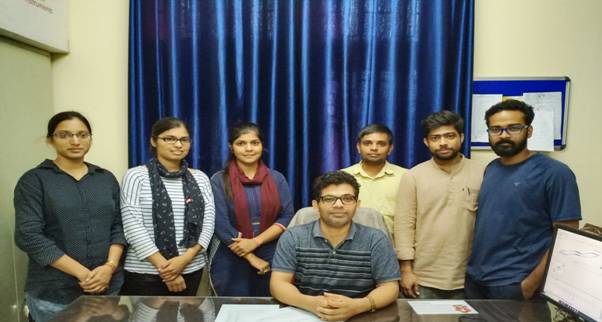
PIB News Update: A recipient of the INSPIRE Faculty Award instituted by the Department of Science & Technology(DST), Govt. of India. Dr. Ashish Kumar Mishra, Assistant Professor at the Indian Institute of Technology (BHU), Varanasi,along with his group, has made significant achievements in developing nanomaterials based supercapacitors to achieve high energy density and power density of supercapacitors.
Increasing energy demand due to the growth of human population and technological advancement poses a great challenge for human society. High energy density of supercapacitors suggests that constant current can be withdrawn for longer duration without recharging. Hence automobiles can run longer distances without charging. Supercapacitors can be an alternative for such purposes.
Dr. Mishra and his research group at IIT (BHU) have developed a reduced graphene oxide (rGO) at a moderate temperature of 100°C with high capacitance performance. The production process is a cost-effective one, making it suitable for commercial purposes. This work has been published in Materials Research Express.
The group which works on carbon (Carbon Nanotubes, Graphene) and metal dichalcogenides (MoS2, MoSe2, etc.) nanomaterials based supercapacitors to achieve high energy density and power density of supercapacitors, have also developed a novel green approach for synthesis of Iron-based nanocatalyst, which can be used for large scale production of Cabon Nanotubes.
In addition to energy storage, Dr. Mishra’s group is also working on optoelectronic applications of nanomaterials. In this context, they are working on developing novel nanostructures of carbon and metal dichalcogenides semiconductors for photodetection and Surface-Enhanced Raman spectroscopy (SERS). Through this work, they have demonstrated excellent photodetection behaviour of different architectures of nanoscale MoS2 for the detection of visible light. The high photoresponsivity obtained in this work can be useful to develop ultrafast detectors for signalling purpose. The work has been published in the Journal of Physical Chemistry Letters.
The SERS can help detect harmful molecules present in water at ultra-low concentrations. His group has successfully demonstrated detection of Rhodamine 6G (R6G), an organic laser dye up to lowest limit of sub-nano-molar concentration using rGO and MoS2 nanomaterials. This work has been published in the Journal of Physical Chemistry C. They have also examined the nonlinear optical response of the material developed, which suggests that some of these materials can be used to develop protectors for high power light sources like lasers.
Their focus on energy and optoelectronics devices paves the way for the development of cost-effective and efficient devices, which can be used for energy storage application. Their findings make way for materials which can be used as advanced photodetectors and also be used as optical sensors for water pollution control.
(Publication:https://doi.org/10.1021/acs.jpclett.9b03726)