


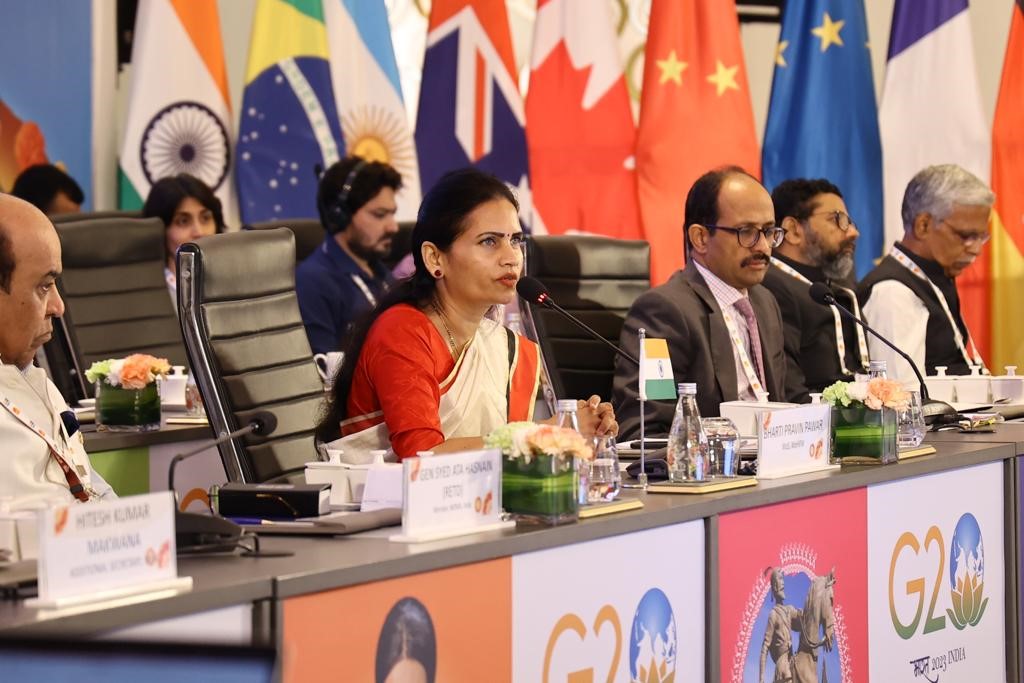
The inaugural session of the Disaster Risk Reduction Working Group (DRRWG) took place in Mumbai, featuring esteemed guests such as Dr. Bharati Pravin Pawar, Minister of State for Health and Family Welfare, and Shri Kamal Kishore, Chair of the working group and Member Secretary of the National Disaster Management Authority (NDMA). Notable attendees included senior officials from the Ministry of Home Affairs (MHA), Ministry of External Affairs (MEA), and the Government of Maharashtra. Additionally, Ms. Mami Mizutori, the Special Secretary to the Secretary General for the United Nations for Disaster Risk Reduction, participated in the DRRWG meeting.
During the opening ceremony, Dr. Pawar emphasized the significance of financing disaster risk reduction as an investment in our future. She highlighted its impact on community safety, health, well-being, economic sustainability, and environmental preservation. Dr. Pawar stressed the importance of collaboration between governments, international organizations, and the private sector to explore innovative methods of mobilizing funds.
The Minister also underscored the relevance of pandemic management and its implications for public health. The COVID-19 pandemic revealed the necessity of integrating emergency preparedness into various development and financial policies. Dr. Pawar emphasized the need to ensure that healthcare systems can effectively withstand the impacts of future disasters.
Dr. Pawar acknowledged that global progress in achieving the disaster risk reduction targets set forth in the 2030 Agenda for Sustainable Development has been insufficient. Despite commendable economic growth, funding for mitigating associated disaster risks has been inadequate, resulting in the loss of lives, infrastructure damage, population displacement, and heavy economic tolls. She emphasized that investing in disaster risk reduction is not only a moral responsibility but also an economic necessity.
According to Dr. Pawar, financing disaster risk reduction requires a multi-sectoral and multi-dimensional approach. It entails investing in early warning systems, preparedness measures, resilient infrastructure capable of withstanding disasters, and adequate resources for post-disaster recovery and reconstruction. She emphasized the importance of long-term recovery efforts and highlighted the significance of international cooperation and support in providing sufficient financial resources for reconstruction and economic revitalization.
Dr. Pawar mentioned that the Government of India is leveraging technology and innovation to enhance disaster preparedness and response. Advanced forecasting systems, remote sensing technologies, data analytics, artificial intelligence, satellite technology, and initiatives like the Sachet Early Warning System have been launched to improve disaster management capabilities.
The Minister also highlighted Prime Minister Narendra Modi’s emphasis on “Recognition and Reform” in disaster management, where vulnerable areas are identified, and efforts are reformed to effectively handle any disaster situation. She further mentioned the Prime Minister’s belief in the philosophy of “Vasudhaiva Kutumbakam” (the world is one family), citing examples such as “Operation Dost” for earthquake relief in Türkiye and the “Vaccine Maitri” initiative for COVID-19 vaccine distribution to nearly 98 countries.
Dr. Pawar expressed India’s commitment to collaborate with the G20 and other international partners in reducing disaster risk and building a more resilient world. She expressed her belief that through collective efforts, a world better prepared for disasters and more resilient to their impacts can be created. The Minister also highlighted the opportunity for G20 nations to lead the way by providing financial support, sharing knowledge, and promoting international cooperation in disaster risk reduction.
The event saw the presence of several dignitaries, including Dr. Ir Udrekh, Director of Disaster Risk Evaluation and Mapping, BNPB, Indonesia; G-20 Chair (India) and Member-Secretary, NDMA Shri Kamal Kishore; Member, NDMA Lt. General (Retd.) Syed Ata Hasnain; Member, NDMA Dr. Krishna Swaroop Vatsa.