


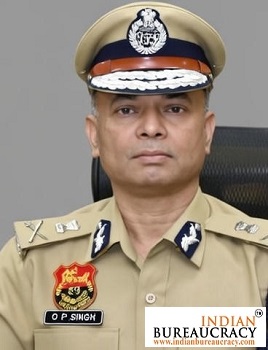
Indian Bureaucracy News, Chandigarh, December 15, 2025 | Late on Sunday night (14.12.2025), the state government appointed Shri O P Singh IPS (Haryana 1992) as the officiating Director General of Police and Head of Police Force, formally upgrading him from the additional charge he held during the past two months. At the same time, Shri Shatrujeet Singh Kapur IPS (Haryana 1990 batch) was relieved of the DGP’s charge and assigned to Haryana Police Housing Corporation.

Shri Kapur, a 1990-batch IPS officer, has now been assigned full charge as Chairman of the Haryana Police Housing Corporation, Panchkula. An engineer by training, he was appointed Director General of Police in August 2023 but was sent on a two-month leave on October 14, 2025, following the death of IPS officer Y Puran Kumar. With his leave ending on Saturday (December 13, 2025), it had been widely expected that he would rejoin on Monday in this role, with around ten months of service remaining before retirement.
While, Haryana has quietly redrawn the top line of its police leadership, but the larger story remains unresolved. On paper, this looks like a routine administrative adjustment. In reality, it reflects a government navigating a narrow path between legal process, public scrutiny, and institutional credibility after the death of senior IPS officer Y Puran Kumar, whose suicide note triggered one of the most serious internal crises the Haryana Police has faced in years.
The decision effectively acknowledges what had become politically and morally untenable, restoring Kapur as police chief while his name figures in a case under active investigation would have deepened mistrust within the force and outside it. Singh’s continuation, now as officiating DGP, offers temporary stability—but only until December 31, when he retires.
That looming retirement is crucial. Haryana had earlier rushed a panel of senior IPS officers to the UPSC to appoint a permanent DGP, only to have it returned with a sharp reminder: proposals should be sent only when a vacancy actually exists. With Singh’s retirement now certain, that vacancy is finally real. The state can legally restart the process under Supreme Court-mandated norms.
Meanwhile, the investigation into Y Puran Kumar’s death has moved into a more sensitive phase. The Chandigarh Police have begun questioning senior and retired officers named in his final note, including former DGPs and serving IPS officers. Statements are being recorded, documents examined, and timelines reconstructed. The inquiry spans allegations of caste-based discrimination, harassment, and institutional failure—charges that go beyond individual culpability and cut into the culture of the system itself.
For the Haryana government, the message is clear: interim arrangements can manage optics, but they cannot substitute for accountability. For the police force, the episode has exposed deep fault lines—of trust, hierarchy, and protection—that will not heal with a single notification.
O P Singh’s appointment buys the state time. What it does not buy is closure. That will depend on the credibility of the investigation, the transparency of the next DGP’s selection, and whether this crisis leads to reform—or simply fades into procedural memory.
IndianBureaucracy.com wishes Shri Om Prakash Singh the very best.