


PIB News Update: There have been some media reports alleging that genome sequencing and analysis of the COVID19 declined sharply in India even as cases of the disease continued to rise. The report further claims that the country sequenced very low number of samples till date.
It is clarified that the number of sequences, as quoted in the report, seems to be taken from Indian COVID19 Genome Surveillance portal (http://clingen.igib.res.in/covid19genomes/ ). The sequences analysed in the IGIB SFTP are as per the collection date of samples and does not depict the number of samples sequenced in a particular month. The samples sequenced by labs of INSACOG consortium also depends on the samples sent by the respective States.
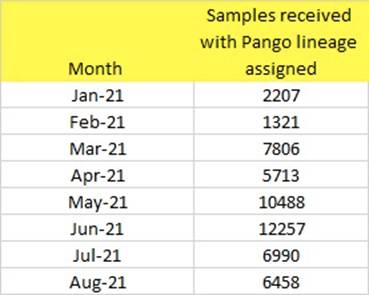
The number of samples sequenced month wise is as follows:
Further, the Initial part sequencing of samples by INSACOG labs was aimed at detecting the Variants of Concern (VOC) among incoming international travellers and also to see whether any person with VOC has entered the country in past one month (double the incubation period of 28 days) from the date of establishment of INSACOG (26th Of December, 2020). For the detection of presence of VOC inside country, 5% of the positives (by RT-PCR) were targeted for sequencing. Both the objectives were achieved by end of January, 2021.
Many states like Maharashtra, Punjab and Delhi started showing rising trends in the month of February and as a response, the sequencing was enhanced in 4 districts of Vidharbha, 10 districts of Maharashtra and around 10 districts of Punjab.
Moreover, the numbers have not been fixed to 300 samples per month or 10 sentinel sites per State. These are the indicative numbers and the States/UTs have been provided the flexibility of identifying more sentinel sites ensuring geographic representation from all parts.
In addition to the sentinel sites, there is the option for the States of sending vaccine break-through, reinfection or other unusual presentation samples for sequencing to INSACOG Labs.
Furthermore, the strategy of sentinel surveillance made sure that samples from each State were geographically well represented as the 5% of random sampling strategy resulted in samples from certain districts being over-represented, while some districts remained unrepresented from States. With the decrease in positivity, the samples availability from the sentinel sites catering to districts with zero or single digit weekly new cases has also gone down. Currently, over 86 districts in the country are having zero weekly new cases.
For the past one month the majority of the new cases are from only two states, namely Kerala and Maharashtra. At present, out of the total 45000 new cases, more than 32000 cases are from Kerala and more than 4000 cases from Maharashtra which means that 80% cases are from 2 states and only 9000 cases, which is around 20%, are from rest of the Indian states. This is also reflected in the samples sequenced from various states.
Since July onwards, for accurate sharing of sample particulars and timely communication of the WGS results, data for samples for WGS by the sentinel sites is being shared via IHIP portal which ensures real-time sharing of sample particulars and WGS results. Accordingly, 9066 samples were sent through sentinel sites in July and 6969 samples were shared in August.
The Month-wise samples received at NCDC with Pango lineages (from various INSACOG labs):