


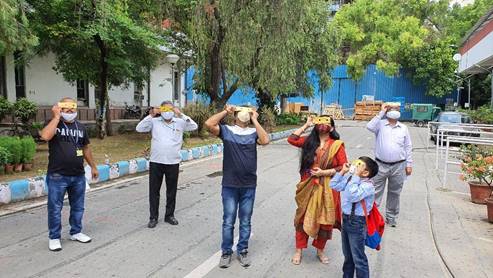
PIB News Update: The National Council for Science & Technology Communication (NCSTC), Department of Science & Technology (DST) in association with Vigyan Prasar organized watching of Solar Eclipse live with solar filter spectacles on 21 June Sunday in the campus of the department. Children, women, scientists, and other officials and staff members enjoyed watching the spectacular celestial event and experienced the thrill of being able to witness the phenomenon of light and shadow that causes an eclipse. Specially designed goggles made of metallic mylar film were provided to the individual viewers produced earlier by NCSTC and Vigyan Prasar. The phenomenon of an eclipse was narrated to the viewers in popular form and photographs of the eclipsing sun taken by using mylar film.
In Delhi, today’s solar eclipse became visible at 10:19:58 in the morning and continued till 01:48:40 in the afternoon. The maximum coverage of the solar disc was seen at 12:01:40 mid-day. With a little cloudy weather, Delhi witnessed the entire sequence of partial eclipse as mostly it remained a sunny day. The annular ring, also known as the Ring of Fire, was visible from parts of Rajasthan, Haryana, and Uttarakhand, including some northern parts of the country, whereas other parts on the belt of eclipse have witnessed a partial eclipse. Incidentally, June 21 also marks the longest day of the year in the northern hemisphere and offers easy viewing of the celestial event. This rare kind of solar eclipse also coincides with the summer solstice, the first day of summer. An eclipse, solar or lunar, offers an opportunity for scientists to carry out various scientific experiments and studies. For science communicators, it is a chance to make people aware of the science behind spectacular celestial show as well as to remove various myths and misbeliefs associated with the eclipses and promote scientific temper.
One may recall that when the Total Solar Eclipse occurred on 16 February 1980, the situation was altogether different from today’s scenario. Most of the people had opted to remain inside their houses to safeguard themselves from so-called ill effects of the eclipse. Except a few science enthusiasts, roads were empty; schools, markets, and many other establishments were closed with the fear of the unknown! Thereafter, another Total Solar Eclipse was visible in India on 24 October 1995 and NCSTC took the lead to organize series of awareness programmes across the country by involving children, teachers, science communication organizations, scientists and common people at large that involving them in safe viewing of the eclipse with the help of mylar film goggles.
The situation started changing with such concerted efforts, and subsequent total solar eclipses have witnessed a sea change in the mindset of the people at large. This time people preferred to come out and experienced the excitement of watching the solar eclipse live, although by following social distancing and precautionary measures. Several autonomous institutions of DST like Aryabhatta Research Institute of Observational Sciences (ARIES), Nainital, Indian Institute of Astrophysics (IIA), Bangalore, and Vigyan Prasar captured the eclipse from different locations and organized live streaming via Zoom, YouTube and Facebook.