


PIB News Update: The satellite that detected the first extreme-UV rays in the Universe from the cosmic noon celebrated its 5th birthday today, September 28, 2020.
The Ultra-Violet Imaging Telescope, or the UVIT, is a remarkable 3-in-1 imaging telescope simultaneously observing in the visible, the near-ultraviolet (NUV), and the far-ultraviolet (FUV) spectrum.
Weighing all of 230 kg, the UVIT comprises of two separate telescopes. One of them works in the visible (320-550 nm) and the NUV (200-300 nm). The second works only in the FUV (130-180 nm). It is one of the five payloads onboard India’s first multi-wavelength astronomical observatory AstroSat and completed five years of operation in the sky by imaging astronomical objects on 28 September 2020.
However, in the five years of its operation, the birthday baby has achieved quite a feat. It has carried out 1166 observations of 800 unique celestial sources proposed by scientists both from India and abroad.
It has explored stars, star clusters, mapping of the large and small satellite galaxies nearby to our own Milky Way galaxy called the Magellanic Clouds, an energetic phenomenon in the Universe such as the ultra-violet counterparts to gamma-ray bursts, supernovae, active galactic nuclei, and so on.
Its superior spatial resolution capability has enabled astronomers to probe star formation in galaxies as well as resolve the cores of star clusters (3 times better than the last NASA mission, GALEX). Observations from UVIT has recently led to the discovery of a galaxy located at a distance of about 10 billion light-years from Earth and emitting extreme ultraviolet radiation that can ionize the intergalactic medium.
AstroSat was launched by the Indian Space Research Organization (ISRO) on 28 September 2015 and has proved to be an important satellite capable of carrying out simultaneous observations over a range of wavelengths from the far ultraviolet to the hard X-ray band.
The UVIT project was led by the Indian Institute of Astrophysics (IIA), an autonomous institute of the Department of Science & Technology, Government of India, in collaboration with the Inter University Centre for Astronomy and Astrophysics, Pune, the Tata Institute of Fundamental Research, Mumbai, several centers of ISRO and the Canadian Space Agency. Several groups from ISRO have contributed to the design, fabrication, and testing of the payload.
“The Ultra-Violet Imaging Telescope, which is a marvelous piece of engineering, is a testimony to the power of several scientific agencies working together in multidisciplinary mode with a shared purpose,” said Prof Ashutosh Sharma, Secretary, DST.
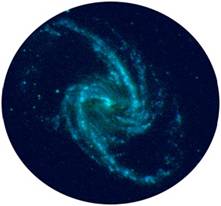
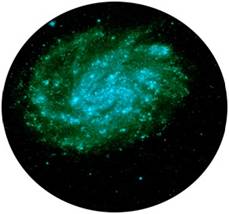
Images from UVIT in the near ultra-violet bands: Left: NGC 300, a spiral galaxy closest to our local group of galaxies. The bright spots in the arms of the galaxy are the intense star-forming regions. Here, green refers to a wavelength of 263.2 nm, and blue refers to a wavelength of 241.8 nm. Right: Zoomed image of NGC 1365, a spiral galaxy with a bar at the center that also hosts an active galactic nucleus powered by a 2 million solar mass black hole. Here green is at 279.2 nm, and blue is at 219.6 nm. (At ultra-violet wavelengths, celestial sources cannot be imaged from the ground).