


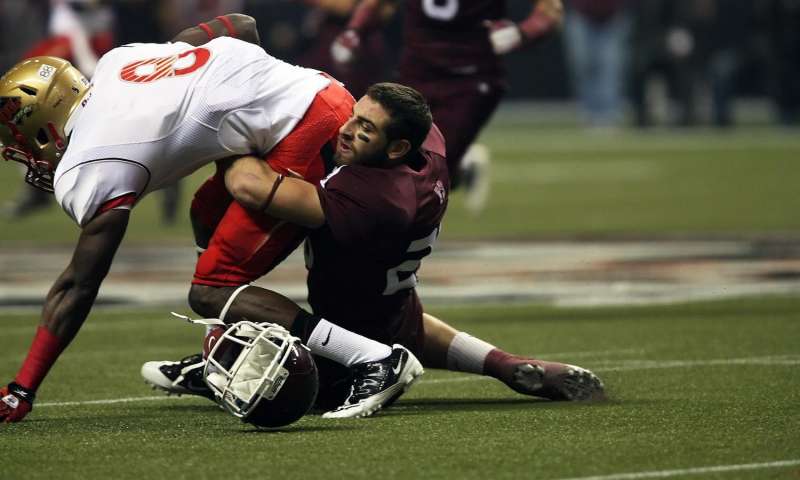
Summary:Whether or not an NCAA Division I athlete is likely to report concussion symptoms depends on factors including their vested interests, their understanding of health implications, and their team culture and societal influences drawn from narratives of performance circulating in media, according to a new study.
Whether or not an NCAA Division I athlete is likely to report concussion symptoms depends on factors including their vested interests, their understanding of health implications, and their team culture and societal influences drawn from narratives of performance circulating in media, according to a study published May 8, 2019 in the open-access journal PLOS ONE by Steven Corman of Arizona State University, USA, and colleagues.
Awareness of concussions as a problem in college sports, as well as the medical impacts of concussions, has increased in recent years. Because many symptoms are internal — such as difficulty thinking, blurry vision, and fatigue — athletes must recognize and report symptoms for treatment to be effective. Current intervention efforts rely on athletes acting self-protectively in reporting concussion symptoms; however leaders in collegiate sports, such as the NCAA, remain concerned about low rates of reporting.
In this study, 401 male and female athletes who played Division I football, soccer, basketball, wrestling, lacrosse, or field hockey at one of 11 participating universities in a Power 5 conference completed a web-based survey asking about their vested interests and risk perceptions related to concussions and severe head impacts. In addition, 90 qualitative interviews were conducted with athletes, coaching staff, and athletic directors to determine organizational and team culture when it comes to concussion education, processes, and communication dynamics.
Overall, the survey data revealed that these athletes were uncertain if they would suffer negative consequences from severe head impacts and perceived that any that did arise would be in the distant future. All schools studied have both men’s and women’s basketball teams, and direct comparisons here showed that male basketball players viewed concussion risks as lower and as further in the future than female players. The interviews revealed that athletes rarely found concussion education memorable, and that coaches tended to be relatively uninvolved in the education process. Athletes expressed that they weighed the costs and benefits of severe head impact reporting by considering not only health implications but impacts on their prospects as a team member and on their team as a whole, as well as possible undesirable reactions from teammates and coaches. Cultural narratives emphasizing performance and organizational culture promoting performance also tend to work against concussion reporting.
Athletes were recruited by availability rather than randomly sampled, and the study’s reliance on qualitative methods and self-reporting risks bias in the collection and interpretation of results. Additionally, the study included basketball athletes; basketball has lower concussion risk than the other sports. It’s not clear whether the findings specific to basketball are generalizable to sports with higher concussion risks. Nonetheless, this study provides initial evidence about the factors which college athletes may weigh when making decisions about reporting concussions and could inform future educational efforts.
Corman adds: “Detecting concussions is about more than helmets and technology. Athlete reporting of head impacts is critical, and their decisions are influenced by a complex mix of cultural narratives, team culture, and their own vested interests.”
More: Science Daily