


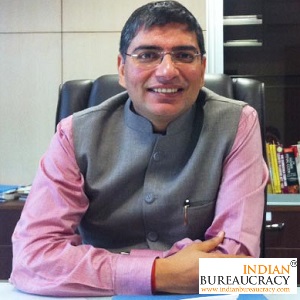
Shri Vikas Gupta IAS (Haryana 2001), presently Commissioner & Secretary, Urban Local Bodies Department, and Member Secretary, Kurukshetra Development Board, has been relieved from his in-cadre responsibilities with immediate effect to facilitate his taking up his assignment under central deputation as Commissioner, Kendriya Vidyalaya Sangathan (KVS). The order follows his placement at the disposal of the Government of India for a full five-year tenure beginning 1 November 2025.
A 2001-batch Indian Administrative Service officer of the Haryana cadre, Shri Gupta belongs to Rajasthan. Born on 19 September 1975, he completed his early education in Jaipur before earning a B.E. in Electronics from Rajasthan University’s Malaviya Regional Engineering College (now MNIT Jaipur), graduating with First Division and Distinction. He later pursued a Master of Public Policy at the University of Oxford, United Kingdom, securing First Division. This places him among the relatively small cohort of IAS officers with advanced policy training from Oxford.
Gupta’s career spans more than two decades across urban governance, district administration, industrial infrastructure, financial management, transport, vigilance oversight, and large public-sector administration. His postings reflect a steady progression through both cadre and ex-cadre responsibilities, covering a notable breadth of state institutions.
In his current roles, he oversaw municipal administration and urban development within the Urban Local Bodies Department, and guided heritage and tourism-linked planning as Member Secretary of the Kurukshetra Development Board. Before this, he served as Commissioner and Secretary in the Citizen Resources Information Department, where he supervised initiatives in e-governance—an area in which he has held recurring assignments, including as Chief Executive Officer of the same department for over three years.
Shri Gupta’s administrative footprint is particularly pronounced in the field of urban development. He has held multiple senior positions in the Haryana Urban Development Authority (HUDA), including Chief Administrator and Chief Vigilance Officer, and served as Managing Director of the Haryana Metro Rail Project. His tenure as Managing Director of the Haryana State Industrial and Infrastructure Development Corporation (HSIIDC) and the Haryana Financial Corporation placed him at the intersection of infrastructure planning and industrial financing, areas frequently cited in state economic policy reviews (Government of Haryana Annual Administrative Reports).
Earlier, Shri Gupta served as Deputy Commissioner in four districts—Rohtak, Jind, Bhiwani, and Mahendragarh—marking a substantial range of field experience in land revenue management and district administration. His early postings also included Sub-Divisional Magistrate roles in Rohtak and Mahendragarh, and a stint in school education administration as Secretary, Haryana School Education Board.
Through these postings, his work has intersected with rural development, small-scale industries, finance, civil aviation, mines and geology, and personnel administration—reflecting the multifunctional nature of cadre responsibilities in the Haryana IAS.
As Shri Gupta moves to Kendriya Vidyalaya Sangathan, he enters one of India’s largest educational administrative systems. According to official data from the Ministry of Education and KVS Annual Reports (2024–25), KVS operates 1,288 schools—1,285 in India and three abroad (Moscow, Kathmandu, and Tehran). It serves approximately 13.62–13.71 lakh students and employs around 56,810 staff, including more than 50,000 teachers. Established in 1963 as “Central Schools” and reorganised as Kendriya Vidyalaya Sangathan in 1965, the system was created to provide a uniform school curriculum for children of Central Government employees with transferable postings. KVS is fully financed by the Government of India and follows the Central Board of Secondary Education (CBSE) curriculum, supported by NCERT textbooks.
The Sangathan is administratively structured into 25 Regional Offices and five Zonal Institutes of Education and Training (ZIETs). In recent years, it has implemented a range of modernisation initiatives, including digital classrooms, smart-board adoption, and NEP 2020-aligned reforms. As of 2025, 913 Kendriya Vidyalayas have been designated as PM SHRI schools, aimed at upgrading infrastructure and pedagogy. The system’s motto, “Tat Twam Pushan Apavrinu,” underscores its emphasis on holistic education.
Shri Gupta’s five-year central deputation, scheduled to run until 31 October 2030, positions him at the helm of an institution that combines scale, administrative complexity, and national educational priorities.
IndianBureaucracy.com wishes Shri Vikas Gupta the very best.