


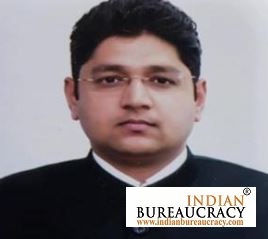
Shri Raghav Langer IAS (UD 2009; Uttarakhand), presently on central deputation and posted at the Joint Secretary level as Secretary, National Medical Commission (NMC), Ministry of Health & Family Welfare, Government of India, New Delhi, he has been granted a one-year extension of his central deputation (order dt 04.12.2025.), which was due to conclude on 3 October 2025, and will now continue until 3 October 2026.
The National Medical Commission (NMC) is India’s apex statutory regulator for medical education and professional standards, established in September 2020 under the National Medical Commission Act to replace the Medical Council of India. Its mandate covers the regulation of undergraduate and postgraduate medical education, accreditation of institutions, oversight of faculty norms, and the maintenance of ethical standards in the medical profession.
The Commission is responsible for formulating policies for curriculum, training and examinations, it coordinates the work of autonomous boards, and exercises appellate jurisdiction over their decisions. It also reviews national requirements for medical manpower and infrastructure and regulates tuition fees for 50 per cent of seats in private medical colleges and deemed universities. In 2024, it introduced revised Competency-Based Medical Education guidelines, including the AETCOM module on attitude, ethics and communication.
To expand capacity in line with national health needs, the NMC approved 10,650 new MBBS seats and 41 additional medical colleges for 2024–25, taking the total number of institutions to 816. For 2025–26, a further 6,850 MBBS seats were sanctioned, pushing the projected annual intake to about 1.24 lakh students.
The Commission is funded through the Ministry of Health & Family Welfare. In the Union Budget 2024–25, the Ministry was allocated ₹1,09,551 crore, with ₹1,275 crore earmarked under “Human Resources for Health and Medical Education,” which includes support for regulatory bodies such as the NMC.
By centralising oversight of medical education, enforcing quality norms, and supervising expansion of teaching capacity, the NMC plays a central role in shaping India’s medical workforce. Its regulations aim to ensure uniform standards of training, improve the availability of medical professionals, and maintain ethical practice at a time of continuing demand for stronger health systems across the country.
IndianBureaucracy.com wishes Shri Raghav Langer the very best.