


Summary:The current technique used for counting lion populations for research and conservation efforts doesn’t add up, according to a researcher. He has been investigating new methods of photographing and reviewing data to count lions.
The current technique used for counting lion populations for research and conservation efforts doesn’t add up, according to a University of Queensland researcher.
But UQ PhD candidate Mr Alexander Braczkowski has been investigating new methods of photographing and reviewing data analytics to count lions.
“African lions receive immense publicity and conservation attention,” Mr Braczkowski said.
“Yet their populations are thought to have experienced a 50 per cent decline since 1994 — coincidentally the same year Disney’s The Lion King was released.
“Current calculations suggest that between 20,000 and 30,000 lions remain in the wild — scattered among 102 populations across approximately 2.5 million square kilometres of Africa.
“Our research shows that the majority of estimates on African lion population and density are based on track counts, audio lure surveys and expert solicitation — which are simply not reliable enough to understand how lion populations are doing over time.”
According to Mr Braczkowski, a recently developed technique has shown promise in better counting big cats and understanding their movements.
“It involves driving extensively and searching actively for lions, and then taking high quality photographs to individually identify them and noting their locations,” Mr Braczkowski said.
“We use an analytical method known as Spatially Explicit Capture-Recapture (SECR).
“For African lions, it was first applied in the Maasai Mara by Dr Nicholas Elliot and Dr Arjun Gopalaswamy, and has now been adopted by the Kenya Wildlife Service and others to survey lions and other carnivores across the country.”
Mr Braczkowski and his colleagues have trialled the technique to better understand the status and density of lions in Uganda’s Queen Elizabeth Conservation Area.
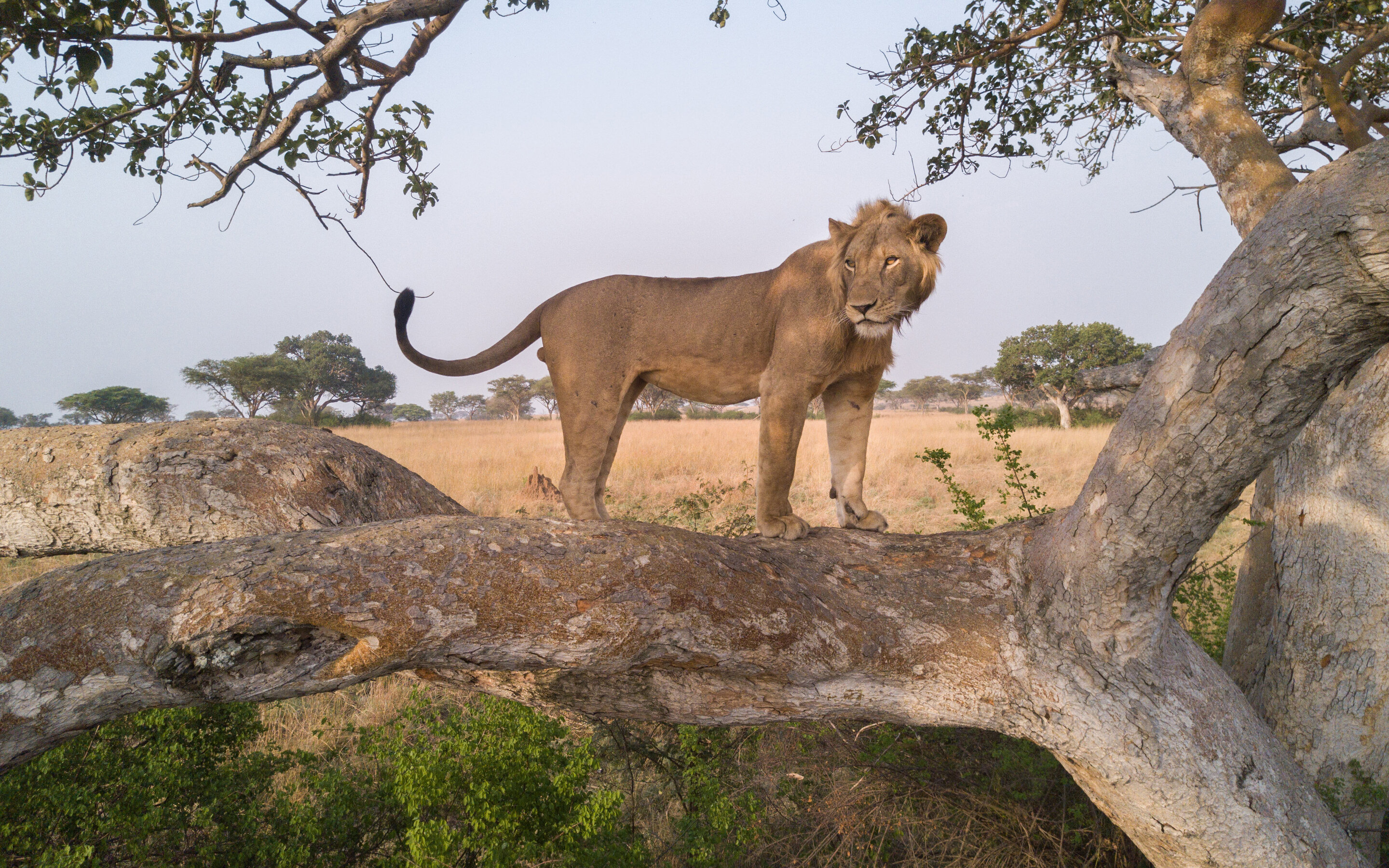
“This was the perfect place to use this novel approach since lions at Queen Elizabeth spend a lot of their time up in trees and it is relatively straightforward to get good pictures of them,” Mr Braczkowski said.
“Due to this unique tree-climbing behaviour, managers and tourists at this park very frequently see lions.
“But, our study showed that these lions are now moving more and have larger home range sizes compared to a previous study conducted about a decade ago
Dr Arjun Gopalaswamy, a co-author and science advisor to the Wildlife Conservation Society’s Global Programs said, since larger home range sizes in big cats are usually associated with reduced density due to poorer prey availability, this is a concerning trend.
“There’s great value in using methods that keep track of lion populations directly and we urge conservation and research communities to cease using ad hoc, indirect methods and shift to more reliable and direct methods.”
More:Science Daily