


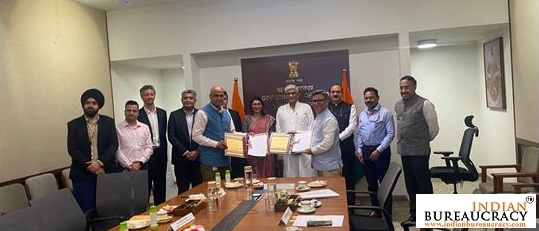
Indian Bureaucracy News, New Delhi, July 01, 2026 | The Ministry of Tourism on Tuesday (June 30, 2026) signed a memorandum of understanding (MoU) with Google India to enhance the digital promotion of India’s tourism destinations using emerging technologies, including artificial intelligence and data analytics.
The agreement, exchanged in the presence of Union Minister for Tourism and Culture Shri Gajendra Singh Shekhawat, Secretary Tourism – Shri Bhuvnesh Kumar IAS (Haryana 1995), Additional Secretary and Director General of Tourism – Shri Suman Billa IAS (Kerala 1996), and Smt Preeti Lobana, Country Manager and Vice President, Google India. The agreement seeks to improve the visibility of India’s cultural and travel offerings among domestic as well as international audiences. Officials said the collaboration would support data-driven decision-making, digital capacity building, and the creation of immersive online experiences for travellers.
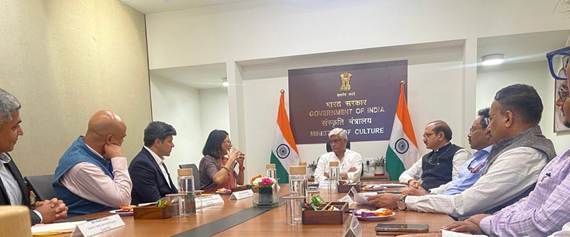
The partnership, which is non-commercial and non-exclusive in nature, entails no financial commitment from either side. It focuses on three broad areas – development of dashboards to track global travel trends and demand patterns; integration of immersive technologies such as augmented reality into the ‘Incredible India’ platform; and training programmes for officials in digital marketing, content creation, and the use of artificial intelligence.
Speaking on the occasion, Shri Shekhawat said “Digital technologies have the potential to create immersive experiences that can showcase the glory and grandeur of India’s cultural sites to audiences across the world.” He noted that the partnership reflects the ministry’s commitment to adopting technology-driven approaches under the Incredible India initiative and will help position India as a modern, accessible, and globally competitive tourism destination.
For everyday travellers, the partnership is expected to make visiting heritage sites more accessible and easier to navigate, particularly for families and first-time visitors. Complex locations such as large forts and temple complexes, which have traditionally posed challenges, are set to become more user-friendly through enhanced digital tools integrated with the ‘Incredible India’ platform and Google Maps.
Among the key features is Live View Walking (AR), which uses a smartphone camera to overlay real-time directional markers, arrows, and contextual information, enabling visitors to move through sites without relying on guides. Address Descriptors, powered by machine learning, help users navigate crowded areas around monuments by identifying prominent local landmarks, making transport and coordination simpler. Additionally, Lens integration in Maps allows users to scan their surroundings and access information on nearby facilities such as restrooms, eateries, ticket counters, and ATMs.
Beyond on-ground navigation, immersive 360-degree previews will allow users to explore heritage sites virtually before planning a visit. Data-driven insights are also expected to help promote lesser-known and rural destinations, offering travellers more diverse and less crowded options.
The Tourism Ministry said the agreement reflects its emphasis on leveraging technology under the ‘Incredible India’ initiative to improve visitor experience while promoting lesser-known destinations.
The government has, in recent years, frequently partnered with Google across sectors to leverage technology for governance and public service delivery. In one such initiative, the Ministry of Culture collaborated with the company to digitally map the physical boundaries of over 3,600 centrally protected monuments under the Archaeological Survey of India (ASI). This geospatial database enables satellite-based monitoring of heritage sites, helps detect encroachments in real time, and supports the preservation of sensitive archaeological zones. Similar engagements across ministries have also focused on areas such as multilingual artificial intelligence, digital education, and the application of satellite data in sectors like agriculture.