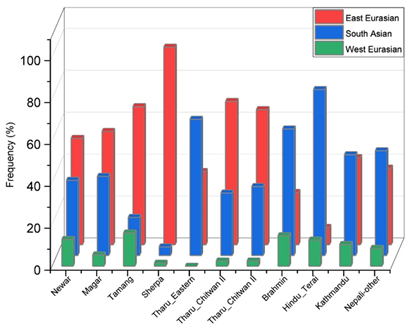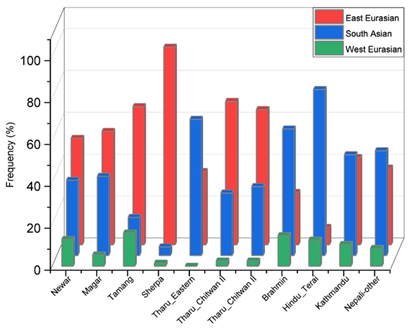
Tibeto-Burman communities were pre-historic Himalayan settlers, and their East Asian ancestry can be traced back to Neolithic immigration, mostly from Tibet around 8 KYA (Kilo Years Ago), says a genetic study of the population. The study, which reconstructs the maternal origins of prehistoric Himalayan populations, helps explain the genetic drift, endogamy, admixture, isolation, and natural selection that have contributed to genetic diversity among Nepalese population and sheds light on migration events that have brought most of the East Eurasian ancestry to the present-day Nepalese population.
It is widely accepted that the modern human originated in Africa around 200000 years ago (KYA) and migrated out of Africa between 60 and 70 KYA. Several populations arose in this process, each with its own evolutionary history. Genetic drift, endogamy, admixture, isolation, and natural selection are a few evolutionary processes that have contributed to genetic diversity among human populations worldwide, including susceptibility and resistance to genetic diseases, infectious diseases, therapeutic response to drugs, and other conditions. Understanding these phenomena is highly relevant in a country like Nepal, which has one of the world’s richest ethnic, cultural, linguistic, and social diversity and harbors several anthropologically well-defined populations. It harbours populations that are phenotypically similar to East Asians (Mongolians/ Tibetans/ Chinese/ southeast Asians); some are similar to South Asians, and some are similar to West Eurasians. Serving as a bridge between the Western and Eastern Himalaya, Nepal offers a unique ground to understand South and East Asian Genetic ancestry.
To understand the genetic diversity and Nepal’s peopling and its ancient history, scientists from Birbal Sahni Institute of Palaeosciences, Lucknow, an autonomous institute of the Department of Science and Technology, conducted a maternal mitochondrial DNA study of several Nepalese populations.
The scientists found that except for high altitude Sherpa population of Nepal, most of the Tibeto-Burman speaking communities of Nepal harbor significant genetic contributions from Tibet, Myanmar, and South Asia, showed shared ancestry with the populations from southeast Tibet, Northeast India, North India (Uttarakhand), Myanmar, and Thailand.
Some of this ancestry exhibit the signature of early admixture and are widespread in several Nepalese populations, including a few Himalayan populations from Uttarakhand, India. The study published in the journal Human Genetics is a step forward in dissecting the complexity of the Tibeto-Burman populations residing in the South of the Himalaya and point to the need for a further study incorporating more populations as well as using other genetic markers.
Publication details
DOI: https://doi.org/10.1007/s00439-022-02488-z