


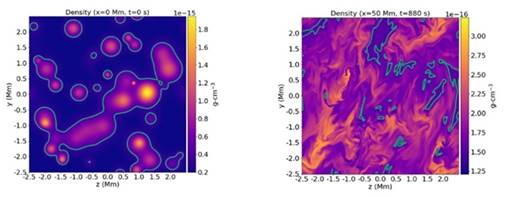
Scientists have developed a new theoretical model to quantify the inhomogeneity in density of solar corona generated by the turbulence in the electrically conducting, magnetized fluid present as plasma in it.
The solar corona is an extremely dynamic medium. It is well established from the last few decades that electrically conducting, magnetized fluid present as plasma which causes magnetohydrodynamic (MHD) wave-driven turbulence, plays an important role in the heating of the solar corona by millions of degrees.
The heating is a factor of a thousand times higher than the solar surface. The exact reason behind heating of the solar corona to such a high temperature is still an open question and is known as the ‘coronal heating problem’ in the solar physics community.
Turbulent motion in a fluid is characterized by chaotic changes in pressure and flow velocity. But, due to the extremely hot temperature in the solar corona, the material in the solar corona becomes like a soup of charged particles, which is called plasma. Propagation of the MHD waves in a plasma medium can cause turbulence. When the MHD-wave propagates through the medium, it carries energy, and the amount of energy depends on the density inhomogeneity of the medium.
Scientists from Aryabhatta Research Institute of Observational Sciences (ARIES), Nainital, an autonomous institute under the Department of Science & Technology, Government of India, have developed a new approach to estimate the amount of density inhomogeneity in the solar atmosphere, which can be quantified by the density filling factor (fraction of the volume occupied by the overdense regions with respect to the entire volume of the medium). This method involves numerical simulation.
This model, Developed by Dr. Samrat Sen, a post-doctoral researcher at KU Leuven, Belgium, and Dr. Vaibhav Pant, published in The Astrophysical Journal, talks about two different methods to calculate the density filling factor. One of the methods involves calculation of the density filling factor from the area measurement obtained from the simulated data. Whereas, in the second method, forward modelling (use of specific model to produce an outcome according to the user interests) is used for the spectroscopic measurement to estimate the density filling factor.
The researchers have found that the theoretically estimated values are in good agreement with the observed values in the solar corona. According to the study, MHD wave-driven turbulence increases the filling factor of the overdense structures, and the medium becomes more density homogeneous.
Publication: Samrat Sen and Vaibhav Pant, (2021), ApJ 923 178
Publication link: https://doi.org/10.3847/1538-4357/AC3003
For more details, Dr. Samrat Sen can be contacted at samrat.sen[at]kuleuven.be
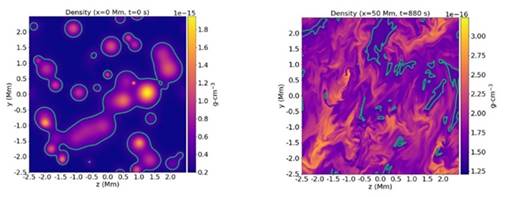
Figure 1: The simulated density structure of the solar corona without turbulence (left) and with turbulence (right). The contours separate the density enhanced region with the background medium.