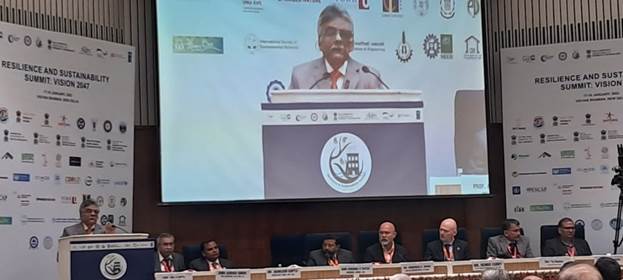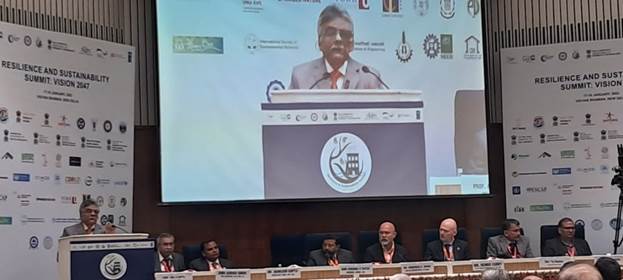
The Resiliency & Sustainability Summit: Vision 2047 brought together experts from all over India and deliberated upon the key aspects of present and futuristic disaster risks and climate contexts as well as their changing scenarios.
“Regional disparity is a central challenge for reducing disaster risk & particularly climate-related disasters in the country,” said Shri Krishna S. Vatsa, Member of the National Disaster Management Authority (NDMA), at the 3 day summit, which started today.
He added that India is making concerted efforts to reduce losses due to disasters by building resiliency which has been demonstrated in reduction of such loss. Member NDMA insisted on the urgent need for the development of vision 2047 to challenge a way forward toward disaster risk reduction, at the summit co-organised by the Department of Science and Technology (DST) along with the National Institute of Disaster Management (NIDM), United Nations Development Programme (UNDP), and GIZ- India.
Secretary Science, Engineering Research Board (SERB) and Senior Adviser DST, Dr. Akhilesh Gupta, emphasised on the significance of socio-economic development in building human adaptive capacity to climate-related disasters. He elaborated on how the poverty & population of India are connected to its vulnerability to climate impacts, resulting in some regions like the east & northeast of India being more vulnerable to climate change.
“Climate Change is a global phenomenon, but has local impacts. Hence local strategies and plans, in addition to National and State level Programmes would be effective in combating it. India is one of few countries which has been doing so much in implementing climate action plan, is one of those getting worst affected by climate. India was supposed to receive US$100 billion per year as part of CoP22 decision at Paris in 2015 but it hardly got any. According a recent report of ESCAP Asia Pacific Disaster report 2022, India needs an annual investment to the tune of US$46.3 Billion for adaptation alone,” Dr Gupta added.
Shri Sudhir Mungantiwar, Minister of Forests, Cultural Affairs and Fisheries, Govt. of Maharashtra spoke about the importance of forests and biodiversity in reducing disasters.
While Dr. Roderico H Afrin, WHO representative to India, underlined the rising risk of diseases due to climate change, Shri Dennis Curry, Deputy Resident to India, spoke about India’s substantive global role in combating climate change.
Experts shared recent lessons, innovations, good practices, and case studies in science, policy-planning-practice interface specific to disaster resilience and risk reduction on the first day of the summit. They also discussed methods for localising resilience agenda for region-specific, sectoral and strategic interventions with futuristic perspectives.
The summit deliberations are expected to identify key contexts of futuristic ‘risk and resilience’ along with a realistic roadmap for ‘localization’ agenda under an integrated strategic framework for Disaster Risk Reduction and Climate Resilience. Besides showcasing SFDRR and cooperation initiatives, this would be an apt occasion to present recent, past, and proposed initiatives as well, including those relating to G-20 Summit, UN Decade for Eco-restoration, and UN Convention to Combat Desertification (UNCCD), etc.