


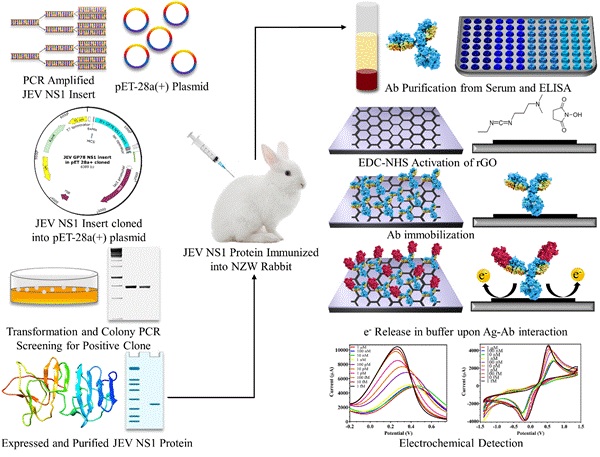
Japanese Encephalitis Virus (JEV) is the leading cause of mosquito-borne encephalitis in South-East Asia and Western Pacific and is often misdiagnosed as Dengue. JEV belongs to the family Flaviviridae and genus Flavivirus and exists in a zoonotic cycle. Since there is no cure available for JEV, early detection is essential to mitigate a breakout. National Institute of Animal Biotechnology, Hyderabad developed Fluorine Doped Tin Oxide (FTO) electrode fabricated with reduced Graphene Oxide (rGO) for as an electrochemical based immunosensor for the rapid, sensitive and specific detection of the Non-Structural 1 (NS1) secretory protein, which is suitable biomarker for JEV found circulating in the blood and has been reported to elicit an immune response. Since the conventional methods for JEV diagnosis are expensive, more hazardous and time-consuming diagnostic techniques and requires an elaborate laboratory set up and trained expertise, the developed biosensor may be able to overcome these limitations. Detection of the NS1 instead of antibody has an added advantage since the antigen is present from day 1 of the infection and hence facilitates early detection. On the other hand, antibodies appear only after Day 4/5 of the infection. Docking studies were used to identify the specificity of the epitopes for different flaviviralNS1 with JEV NS1 antibody paratopes, followed by JEV NS1 sequence amplification, cloning and transformation. The NS1 protein was expressed in E. coli, characterised, and immunized in rabbits to raise the polyclonal antibodies. The NS1 Antibodies were purified from serum, characterized, and used as the bioreceptor to fabricate the electrode with reduced graphene oxide as a conductivity enhancing nanomaterial for the detection of JEV NS1 antigen (Ag). The LOD (limit of detection) was determined as 0.92 fM in buffer and 1.3 fM in spiked serum ranging from 1 fM-1 µM. This detection range is more sensitive than other sensors developed for JEV and can detect the minimal infective dose of circulating NS1 ranging anywhere from 7-284 ng/ml in clinical samples as tested in other flaviviral infections. The fabricated immunosensor was also specific towards JEV NS1Ag as compared to other flaviviral NS1Ag. Therefore, the proposed immunosensor could be a promising candidate for the development of an accurate, and rapid, diagnosis for specific and sensitive detection of JEV from clinical samples.
(Publication details: Akanksha Roberts, VeerbhanKesarwani, Rupal Gupta, Sonu Gandhi. Electroactive Reduced Graphene Oxide for highly sensitive detection of secretory Non-Structural 1 protein: A potential diagnostic biomarker for Japanese encephalitis virus; Biosensors and Bioelectronics 2022; 198:113837; PMID: 34864242 DOI: 10.1016/j.bios.2021.113837 (Impact Factor- 10.618)
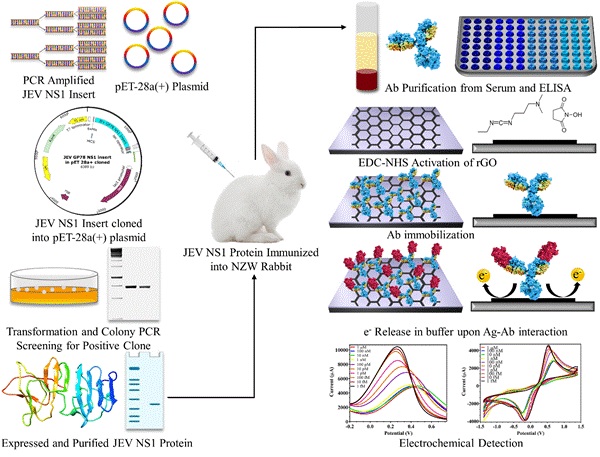
Expression of recombinant JEV NS1 protein, generation of JEV NS1 Ab and immunoassay development, and fabrication of an immunosensor for the detection of JEV NS1 Ag using electrochemical methods.