


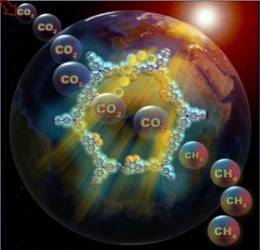
Indian Scientists have designed a cost-effective metal-free catalyst to convert carbon dioxide to methane by absorption of visible light. Ongoing research is making a significant effort to reduce CO2 into value-added products, methane (CH4) could be one of the value-added products with significant uses as the cleanest burning fossil fuel and can directly be used in fuel cells as a hydrogen carrier. It is also the main component of natural gas and has the potential to replace coal for electricity generation and furnishing flexible supply to reinforce intermittent renewable generators.
There are several ways in which CO2 can be reduced, including photochemical, electrochemical, photoelectrochemical, photothermal, and so on. The photochemical process utilizes solar light as a renewable energy source.
There are some key requirements of a photo-catalyst to convert CO2 into value-added products, which rely upon the light-harvesting property, charge carrier (electron-hole pair) separation proficiency, and presence of proper electronically aligned conduction band. Thus, it is a challenge to reduce CO2 to CH4 selectively and efficiently. Only a handful of catalysts are able to reduce CH4 selectively and efficiently, and most of the catalyst contains metal counterparts which are toxic and expensive.
In order to overcome this challenge, a team of Scientists from Jawaharlal Nehru Centre for Advanced Scientific Research, an autonomous institute of the Department of Science & Technology, Government of India, have designed a metal-free porous organic polymer in such a way that it will be able to absorb visible light and catalyze the CO2 reduction reaction as well.
They have prepared a donor (tris-4-ethynylphenylamine)-acceptor (phenanthaquinone) assembly via C-C coupling to form a robust and thermally stable conjugated microporous organic polymer which was utilized as a heterogeneous catalyst. The keto group present in phenanthraquinone moiety acted as a catalytic site in contrast with other conventional metal-based catalysts where the metal counterpart carries out the CO2 reduction reaction (CO2RR). During the catalysis process, first, the chemical called the conjugated microporous polymer (CMP) could uptake CO2 onto its surface due to its high CO2 intake capability at room temperature, converting it into methane as a value-added product. The synergistic push-pull effect between the electron-rich donor and electron-deficient acceptor facilitated efficient electron-hole separation, enhancing electron transfer kinetics and assisting in efficient catalysis. This work has been accepted for publication in the Journal of the American Chemical Society. The utilization of a cost-effective, metal-free system with a high production rate of CH4 can lead to a new strategic way to assemble carbon capture and reduction based on efficient porous heterogeneous catalysts.
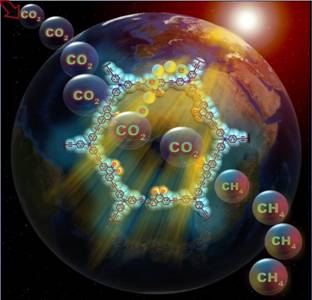
Schematic showing CO2 capture and visible-light-driven conversion of CO2 to solar fuel CH4 using a metal-free redox-active conjugated microporous polymer.

Prof. Tapas. K. Maji Dr. Soumitra Barman Dr. Ashish Singh Faruk Ahamed Rahimi
Publication link: 10.1021/jacs.1c07916.
For more details, Prof. Tapas K. Maji may be contacted at [email protected].