A new aqueous electrolyte that can help make electrochemical ammonia synthesis more efficient will be useful for industries producing green energy or hydrogen.
The electrochemical ammonia synthesis is largely limited by the poor solubility of nitrogen (N2) in the aqueous electrolyte environment as well as the competitive hydrogen evolution reaction. The obstacle faced was that reduction of N2 has actually occurred in the aqueous medium. In an attempt to solve these issues, the “ambient” conditions are mostly overseen. Researchers mostly work on catalyst development, while electrolyte improvisation still remains in infancy. According to a recent report, 90.7 % of the research works related to : Nitrogen reduction reaction (NRR) have focused on the suitable catalyst development, while only 4.7 % have been devoted to work on the electrolytes.
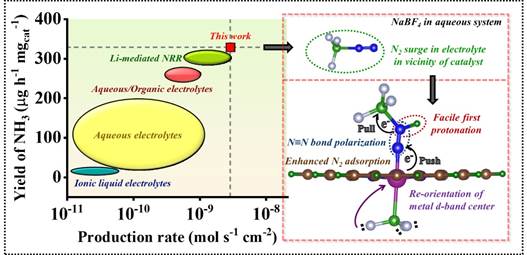
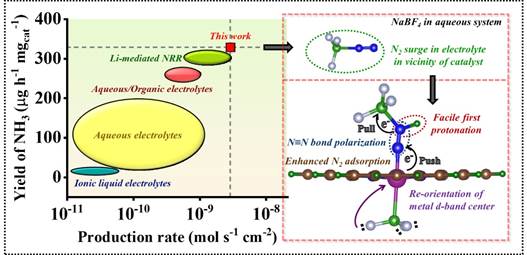
Scientists from Institute of Nano Science and Technology (INST) Mohali, an autonomous institute of Department of Science and Technology (DST), have introduced a new electrolyte called (NaBF4), which not only acts as an N2-carrier in the medium but also works as a full-fledged “co-catalyst” along with active material transition metal-doped nanocarbon (MnN4) to deliver high yield of ammonia (NH3) at absolutely ambient experimental conditions. The high production rate of NH3 approached industrial scale and exceeded almost all the standard catalysts in any other electrolyte medium. The source of NH3 was thoroughly studied and confirmed to be chiefly from the electrochemical reduction of the purged N2 gas (make it N2 saturated electrolyte to convert N2 to NH3.
This research published in the journal PNAS is a novel approach to get through the long-standing issues about the solubility of N2 in aqueous medium and achieve industrial scale production rate of ammonia by NRR at ambient condition.
This work supported by DST SERB brings an user-friendly aqueous electrolyte (NaBF4) which can encourage researchers to work more on aqueous electrolyte designing towards an even improved NRR performance of the electro catalysts. A patent has been filed for this work and the scientists are now working towards making electrolyzer for rapid rate of ammonia production at an industrial scale.
Publication link: doi.org/10.1073/pnas.2204638119
For more details, please contact Dr. Ramendra Sundar Dey, Email: [email protected].