


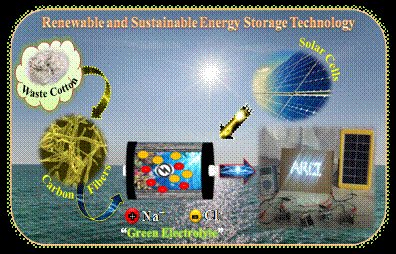
PIB News Update: Scientists at the International Advanced Research Centre for Powder Metallurgy and New Materials (ARCI), an autonomous organization of the Department of Science and Technology, Govt. of India have developed a simple, low-cost, environmentally friendly, and sustainable supercapacitor electrode derived from industrial waste cotton which can be used as an energy harvester storage device. For the first time, natural seawater is explored as an environmentally friendly, cost-effective, scalable, and alternative aqueous electrolyte, which may replace the existing aqueous-based electrolytes for the economic fabrication of supercapacitor.
Supercapacitor is a next-generation energy storage device that has received extensive research attention owing to advantages such as high power density, long durability, and ultrafast charging characteristic as compared to conventional capacitors and lithium-ion batteries (LIB). Among the four main components of supercapacitor electrode, electrolyte, separator, and the current collector, the first two are the pivotal components, which directly determine the electrochemical behaviour of the supercapacitors. The fabrication cost of electrode materials, as well as electrolytes, should be reduced because these two components account for major portion of the device manufacturing cost.
In search of a cost-effective material for making affordable supercapacitor devices, scientists at ARCI have converted industrial waste cotton (Trash) into highly porous carbon fibers (Treasure) by activation process and then utilised the porous carbon fibers to make high-performance supercapacitor electrodes.
In the recent research published in Energy Technology, scientists at ARCI demonstrated the feasibility of using seawater as natural electrolyte for the fabrication of aqueous-based supercapacitor devices which shows great potential for practical implementation. The study found that natural seawater-based supercapacitor exhibited maximum capacitances at a current density of 1 Ag-1. In addition, seawater-based supercapacitor shows very good durability upon 10,000 charge-discharge cycles with 99 % of capacitance retention and 99 % of Coulombic efficiency (efficiency with which charge is transferred in a system facilitating an electrochemical reaction).
The research team’s new, sustainable and green supercapacitor device shows great potential for practical application, and perhaps most importantly, the integrated solar cell with seawater-based supercapacitor as low cost, eco-friendly, efficient and self-powering device. The successful demonstration of the device revealed that solar-powered supercapacitors can not only store the electrical energy but also overcome the drawbacks of the intermittent nature of the solar irradiation. Hence, the integrated solar cell with supercapacitor can be used as an energy harvester storage device due to their long cycle life and maintenance-free power supply.
“The large-scale use of renewable energy requires creation of matching capacity for inexpensive electrical energy storage. This study provides a solution for fabrication of super-capacitors from such abundant materials as waste cotton and seawater! It is an excellent example of the creative science for the sustainable, green processes embedding principles of waste-to-wealth,” said Prof Ashutosh Sharma, Secretary, DST.
[Publication links:
https://doi.org/10.1002/ente.202000417
https://doi.org/10.1016/j.carbon.2018.08.052
For further details contactDr. Mani Karthik ([email protected])]