



Astronomers exploring regions on the Sun with disturbed magnetic fields or active regions that sometimes exhibit solar flares without accompanying Coronal Mass Ejection (CME) have confirmed that changing structure of the magnetic field on the Sun’s surface determined whether a flare or a CME was emitted. This understanding will be useful in improving predictions of solar weather, which can affect electrical, and communication systems in Earth and satellite systems in space.
The Sun has a complex magnetic field near its surface that is connected to its hot plasma and changes its configuration all the time as the plasma itself moves around in this field. This magnetic field can erupt out of some regions (called Active Regions) on the Sun’s surface in loops, become twisted, realign its geometry, and release tremendous amounts of energy in the process, which was stored as magnetic energy till then. The light (in many wavebands) emitted in this process is called a solar flare. On the other hand, a CME is when a huge amount of hot gas, with its embedded magnetic field, is ejected at high velocities into the solar corona. It is known that some Active Regions produce flares, some produce CMEs, and some produce both. What determines this difference remained a puzzle though earlier studies indicated that the mystery lies in the magnetic field in this region.
The underlying magnetic configuration that stores energy is typically seen having twisted magnetic fields, which are quantified by a parameter known as magnetic helicity. The corona of the active region (AR) is being pumped with such twists or magnetic helicity. When helicity reaches beyond a threshold level, CME is the only way to remove the excess helicity. However, finding the threshold level of the coronal helicity budget is still a formidable problem for the prediction of a CME eruption in due course of the AR evolution.
Dr. P. Vemareddy from the Indian Institute of Astrophysics, Bengaluru, an autonomous institute of the Department of Science & Technology, Government of India, first spotted a peculiar evolution of helicity injection in the Active Region called AR 12257 without CMEs. The scientists studied this astronomical event based on the magnetic and coronal images of the Sun, taken every 12 minutes by NASA’s Solar Dynamics Observatory in space, and found that the AR injected positive helicity in the first 2.5 days followed by negative helicity after that. The study showed that active regions where the sign of the helicity (or twist) reverses with time cannot produce coronal mass ejection.
The results have been published in the journal Monthly Notices of the Royal Astronomical Society.
“Surprisingly, the magnetic structure that we derived from the data did not show any twist in the core of the active region,” said Dr. Vemareddy. According to the IIA team, studies of how helicity is injected seem to be key to predict the eruptive potential of an active region, and these results are expected to shed light on magnetic field production in stars and planets as well.
Publication link: https://doi.org/10.1093/mnras/stab2401
For more details, Dr. P. Vemareddy ([email protected]) can be contacted.
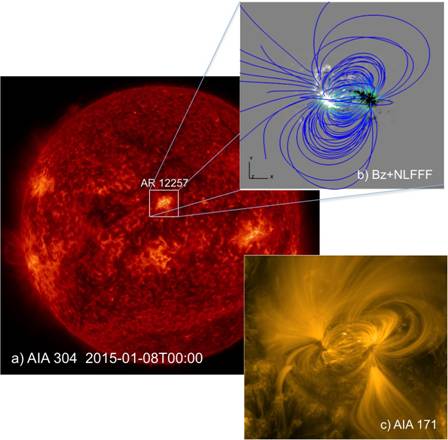
Figure 1 Image of the Sun in extreme ultraviolet waveband 304 Å showing the AR 12257 enclosed by white-rectangle. The modelled magnetic structure (b) and the coronal plasma tracers in the waveband 171 Å (c).