


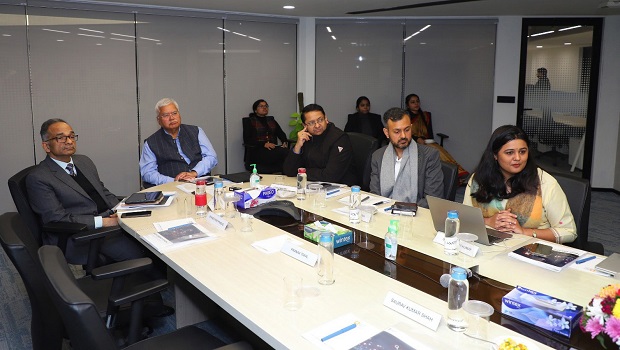
Second Meeting of India Energy Stack (IES) Taskforce Held
The second meeting of the India Energy Stack (IES) Taskforce was convened today, bringing together Taskforce members along with representatives from the Ministry of Power, sectoral regulators, industry leaders, academia, and other key stakeholders. The deliberations reflected a growing convergence around the role of IES as a foundational digital framework for India’s power sector, with discussions marked by constructive inputs and a shared focus on practical implementation.
The meeting primarily reviewed the Version 0.2 drafts of the IES Strategy and Architecture documents. These drafts have been prepared in line with the guidance and direction provided during the inaugural Taskforce meeting held under the aegis of the Ministry of Power. In that first meeting, members had collectively agreed on positioning the India Energy Stack as India’s Digital Public Infrastructure (DPI) for the power sector, anchored in the principles of modularity, interoperability, open standards, and real-world implementability. The Version 0.2 documents represent a natural progression from conceptual alignment to a more execution-oriented roadmap.
The updated Strategy document places sharper emphasis on translating vision into action. It proposes developing IES through comprehensive “use case packages,” ensuring that policy intent, technology design, and operational workflows move forward in an integrated manner. A structured rubric has been introduced to prioritise early use cases, allowing stakeholders to focus on areas that offer maximum impact and feasibility in the near term. The document also maps existing national digital platforms relevant to the power sector, highlighting opportunities for convergence rather than duplication. In addition, it outlines a strengthened data governance framework, including the rationale for a National Power Sector Data Policy, aimed at ensuring secure, responsible, and value-driven use of sectoral data.
The meeting was attended by a distinguished group of experts and practitioners, underscoring the collaborative and multi-disciplinary character of the Taskforce. Participants included Taskforce Chairman Dr. Ram Sewak Sharma (Former Director General, UIDAI; Former CEO, National Health Authority; Former Chairman, TRAI); Shri Pradeep Kumar Pujari (Vice Chair, Distinguished Fellow, FSR Global; Former Chairman, CERC; Former Secretary, Power); Shri Pramod Verma (Co-founder, FIDE; former Chief Architect, Aadhaar); Shri Alok Kumar (Director General, AIDA); Shri Jitendra Srivastava (Chairman and Managing Director, REC Limited); Shri Abhishek Ranjan (CEO, BRPL); Shri Vikram Gandotra (President-Elect, IEEMA); Shri Vikram Dhaka (Representative, MNRE); Shri Swetha Ravi Kumar (Executive Director, FSR Global); Dr. Rahul Tongia (Senior Fellow, CSEP); Shri Reji Pillai (President, ISGF); and Shri Pranav Tayal (Director, Ministry of Power). Several other dignitaries and stakeholders joined the meeting through video conferencing, reflecting broad-based interest in the initiative.
Addressing the gathering, Shri Jitendra Srivastava, Chairman and Managing Director, REC Limited, described the India Energy Stack as a significant step towards creating a unified and trusted digital backbone for the power sector. He noted that Version 0.2 demonstrates the Taskforce’s collective maturity and a clear shift from ideation to execution. As the Nodal Agency for IES, REC Limited reaffirmed its commitment to working closely with the Ministry of Power and ecosystem partners to convert the framework into implementable standards and scalable solutions that can deliver measurable benefits on the ground.
The Version 0.2 Architecture document further refines the technical blueprint of IES, with a strong emphasis on trust, security, and governance by design. Core elements include digital identity, verifiable credentials, secure application programming interfaces (APIs), auditability, and policy-as-code to enable consistent and transparent rule enforcement. To support faster adoption, these components are complemented by sandboxes, reference implementations, and clearly defined conformance pathways, allowing participants to test, adopt, and scale solutions with confidence.
As part of the accelerator programme to demonstrate real-world applicability, pilot distribution companies (DISCOMs) have been encouraged to adopt and implement inter-state peer-to-peer (P2P) power trading using the defined APIs and specifications. This initiative is expected to provide valuable insights into operational readiness, regulatory alignment, and ecosystem response.
Overall, the second Taskforce meeting marked a steady and purposeful step forward in the evolution of the India Energy Stack. The progress achieved aligns with broader discussions often highlighted in Indian Bureaucracy Latest News, where digital public infrastructure is increasingly seen as a catalyst for systemic reform. The IES project is scheduled for completion by July 2026, with the coming phases expected to further consolidate stakeholder collaboration and on-ground implementation.