


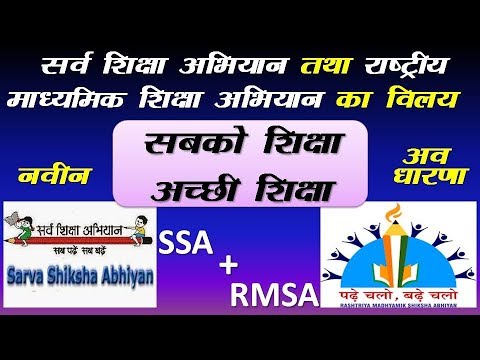
Minister of State (HRD), Dr. Satya Pal Singh t has infomed thatThe Government of India has taken several initiatives to provide ‘Sabko Shiksha Achchi Shiksha’ i.e. for making available good quality education, accessible and affordable for all. In pursuance of the proposal of the Union Budget, 2018-19, to treat school education holistically without segmentation from pre-school to Class XII, the Department of School Education and Literacy has launched the Samagra Shiksha – an Integrated Scheme for School Education as a Centrally Sponsored Scheme with effect from the year 2018-19. This programme subsumes the three erstwhile Centrally Sponsored Schemes of Sarva Shiksha Abhiyan (SSA), Rashtriya Madhyamik Shiksha Abhiyan (RMSA) and Teacher Education (TE).
Samagra Shiksha is an overarching programme for the school education sector extending from pre-school to class XII and aims to ensure inclusive and equitable quality education at all levels of school education. It envisages the ‘school’ as a continuum from pre-school, primary, upper primary, secondary to senior secondary levels. The main emphasis of the Scheme is on improving quality of school education and the strategy for all interventions would be to enhance the Learning Outcomes at all levels of schooling. The Objectives of the Samagra Shiksha are (a) Provision of quality education and enhancing learning outcomes of students; (b) Bridging Social and Gender Gaps in School Education; (c) Ensuring equity and inclusion at all levels of school education; (d) Ensuring minimum standards in schooling provisions; (e) Promoting Vocationalisation of education; (f) Support States in implementation of Right of Children to Free and Compulsory Education (RTE) Act, 2009; and (g)Strengthening and up-gradation of SCERTs/State Institutes of Education and DIET as nodal agencies for teacher training.
The major features of Samagra Shiksha are as under:-
- Provision for up-gradation of schools up-to senior secondary level and strengthening of school infrastructure as per norms.
- Composite school grant increased from Rs. 14,500-50,000 to Rs. 25,000-1 Lakh and to be allocated on the basis of school enrolment.
- Annual Grant for sports equipment at the cost of Rs. 5000 for Primary Schools, Rs.10,000 for upper primary schools and up to Rs. 25,000 for secondary and senior secondary schools.
- Annual grant for Library at the cost of Rs. 5,000/- for Primary School, Rs.13,000/- for composite Elementary school, Rs. 10,000/- for Secondary school (Class 9th & 10th), Rs.10,000/- for Senior Secondary school (Class 11th & 12th), Rs. 20,000/- for composite Senior Secondary school (Class 1st to 12th).
- Allocation for Children with Special Needs (CwSN) increased from Rs. 3,000 to Rs. 3,500 per child per annum including a stipend of Rs. 200 per month for CWSN girls to be provided from Classes I to XII – earlier it was only for classes IX to XII.
- Allocation for uniforms enhanced from Rs. 400 to Rs. 600 per child per annum.
- Allocation for textbooks enhanced from Rs. 150/250 to Rs. 250/400 per child per annum.
- Upgradation of Kasturba Gandhi Balika Vidyalayas (KGBVs) from Class 6-8 to Class 6-12.
- Strengthening Teacher Education Institutions like SCERTs and DIETs to improve the quality of teachers with SCERT as the nodal institution for in-service and pre-service teacher training
- Enhanced use of digital technology in education through smart classrooms, digital boards and DTH channels.