


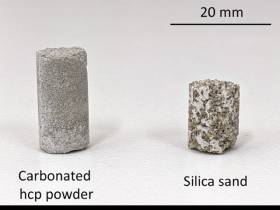
Summary:A new kind of concrete could reduce emissions from the construction industry. Calcium carbonate concrete is made from waste concrete and carbon dioxide from the air or industrial exhaust gases. It shows promise as a future construction material, especially in places where natural resources are limited.
A new kind of concrete could reduce emissions from the construction industry. Calcium carbonate concrete is made from waste concrete and carbon dioxide from the air or industrial exhaust gases. It shows promise as a future construction material, especially in places where natural resources are limited.
The modern world is built from concrete. Every tall building in every city on Earth uses the durable and versatile material to give it shape and strength. The concrete industry therefore is enormous, and this comes at a cost: It is estimated that around 7% of the world’s carbon dioxide emissions come from the manufacture and use of cement, the main component of concrete. And a large proportion of this 7% is due to the necessary use of calcium, which is usually obtained by burning limestone.
A new way to reduce emissions levels caused by concrete use has been proposed and proven to work by Professor Ippei Maruyama and C4S (Calcium Carbonate Circulation System for Construction) project manager Professor Takafumi Noguchi, both from the Department of Architecture at the University of Tokyo. They have found a way to take waste concrete and captured carbon dioxide, and combine them in a novel process into a usable form of concrete called calcium carbonate concrete.
Inspired by the way some aquatic organisms harden into fossils over time, Maruyama wondered if the same process that forms hard calcium carbonate deposits from dead organic matter could be applied to concrete. Calcium is essential for the reaction between cement and water to form concrete, and Maruyama saw this as an opportunity to investigate a less carbon-intensive way of performing the same function.
“Our concept is to acquire calcium from discarded concrete, which is otherwise going to waste,” said Maruyama. “We combine this with carbon dioxide from industrial exhaust or even from the air. And we do this at much lower temperatures than those used to extract calcium from limestone at present.”
Calcium carbonate is a very stable material, so makes for a durable construction material. And the ability to recycle large quantities of material and waste is a great benefit. However, calcium carbonate concrete cannot replace typical concrete at present. It is not quite as strong as typical concrete, though for some construction projects, such as small houses, this would not be a problem. Also at present, only small blocks a few centimeters in length have been made.
“It is exciting to make progress in this area, but there are still many challenges to overcome,” said Noguchi. “As well as increasing the strength and size limits of calcium carbonate concrete, it would be even better if we could further reduce the energy use of the production process. However, we hope that in the coming decades, carbon-neutral calcium carbonate concrete will become the mainstream type of concrete and will be one of the solutions to climate change.”
Funding This research was funded by the NEDO Moonshot project, C4S Research and Development Project, Calcium Carbonate Circulation System for Construction
More: Science Daily