


PIB News Update: Scientists have developed a new technique to measure DNA modifications that can have applications in early diagnosis of multiple diseases like Cancer, Alzheimer’s, and Parkinson’s diseases.
Alteration in DNA affects their expression and functions. DNA controls cell survival through the genetic code as well as via modifications to its structure. There is a demand for techniques with very high resolution to measure such modifications of DNA structures and observe and understand the molecular mechanisms associated with it to track rare diseases.
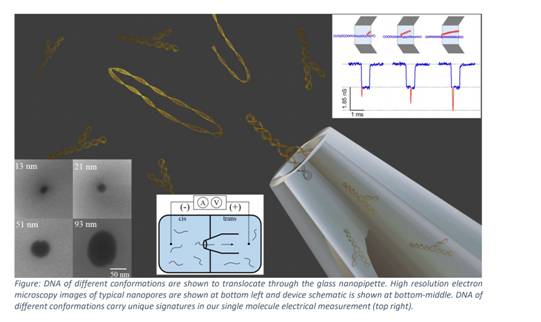
The novel nanopore-based platform developed by the scientists can directly measure such modifications or branched DNA properties with the single-molecule resolution even with extremely low amounts of sample.
The platform and associated analysis techniques developed by a team of scientists led by Professor Gautam Soni from Raman Research Institute, an autonomous Institute funded by the Department of Science & Technology, Government of India can quantitatively assess the distribution of supercoiled branches on DNA plasmids (DNA molecule outside the chromosome). This research work done by researchers Sumanth Kumar, Koushik S., and Dr. Soni has been recently published in the journal ‘Nanoscale’.
The measurement principle of the novel platform is analogous to the Archimedes principle. Individual analyte molecules are driven through a nanopore under an applied voltage, which, during translocation, results in a tiny electrical blip. Charges excluded by the analyte (supercoiled DNA) in the nanopore is directly proportional to the volume of the particle and is directly measured as the current change. This method utilizes extremely low amounts of sample and can measure DNA structural changes ranging to a few nanometers resolution in the axis perpendicular to the translocation and few tens of nanometers along the translocation axis.
Further optimization of the technique can help in the development of portable nano-bio sensors for detection and quantification of protein aggregates and cell-free DNA or nucleosomes. This may help in the early diagnosis of many diseases like Cancer, Alzheimer’s, and Parkinson’s diseases. Currently, researchers at RRI are also exploring applications of this method for virus detection.
[Publication link:
https://doi.org/10.1039/D0NR06219G
For more details, Professor Gautam Soni ([email protected]) can be contacted.]