


Summary:Many satellites are in space to take photos. But a vibrating satellite, like a camera in shaky hands, can’t get a sharp image. Pointing it at a precise location to take a photo or perform another task, is another important function requiring accuracy.
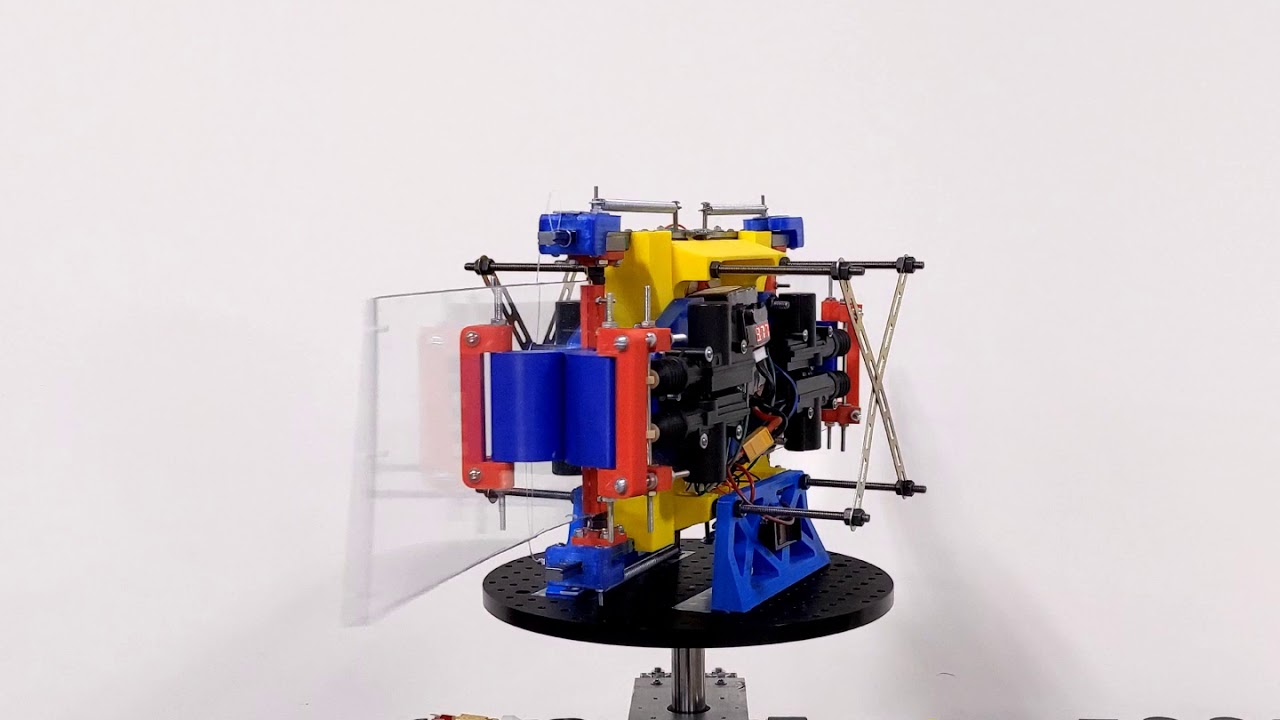
Many satellites are in space to take photos. But a vibrating satellite, like a camera in shaky hands, can’t get a sharp image. Pointing it at a precise location to take a photo or perform another task, is another important function that requires accuracy. Vedant, an aerospace engineering doctoral student at the University of Illinois at Urbana-Champaign was working on a way to eliminate vibrations on a satellite when he discovered his invention could also rotate the satellite.
“We developed, with NASA”s Jet Propulsion Lab, a way to cancel out the vibrations of a satellite by vibrating the solar panels in the opposite direction — active noise cancellation,” Vedant said. “After developing a mathematical model and using random inputs, I realized I could make the satellite move away from the original resting point, which was unexpected. On further analysis, I discovered that a new capability existed in the system — in addition to the vibration isolation, it can actually rotate the satellite in space arbitrarily.”
Vedant explained that in space, you only have the capabilities of throwing masses around, using only the satellite’s internal forces to move. He likened the controlled movements of the satellite’s solar panels to the movements a cat makes when falling to land on its feet — twisting its body by stretching out its legs, then pulling them in tightly.
“The solar panels are long and flexible,” Vedant said. “If you swing one down, it will rotate your spacecraft by a small amount of angle. When you contract it, that shouldn’t change the angle at all, because that’s just a contraction. But, I’m also changing the length of the solar panel — that changes the moment of inertia, which moves it back a slightly different amount. And if you do this repeatedly, you can then begin adding these angles. That’s what’s new about this multifunctional structures for attitude control.”
Vedant described how he first recognized the potential to rotate the satellite. For the original project with JPL, there was an outreach component so Vedant created a game for STEM students to play.
“I mapped it to the keyboard keys, so that each key made it oscillate in one direction,” he said. “I was pressing random keys to see if the system works or not and it did something very unusual. It stopped shaking, but instead of moving back to its original position, it moved to a different place and stopped. I thought that was a mathematical error. So I dug more into it. And it turned out to be a new way of moving the panel.”
Vedant said U of I has obtained a patent on his invention. Since it went public in early February, there has been a surge of interest in it from companies that design, build, and launch satellites.
He created a video of the prototype, which was made from a 3D printer: https://www.youtube.com/watch?v=dW8nWlNwG2c.
“My next effort is to make something that is that is more realistic and can fly in space,” Vedant said. “We’ll also be looking at ways to integrate the electronics into the solar panels, to save on the volume and weight.”
Vedant plans to continue to develop the technology and eventually license it to companies. He received a master’s degree in aerospace engineering in 2018. His doctoral adviser is James Allison in the Department of Industrial and Enterprise Systems Engineering at Illinois and an affiliated faculty member with the Dept. of Aerospace Engineering. Vedant’s co-adviser is Alexander Ghosh.
More: Science Daily