


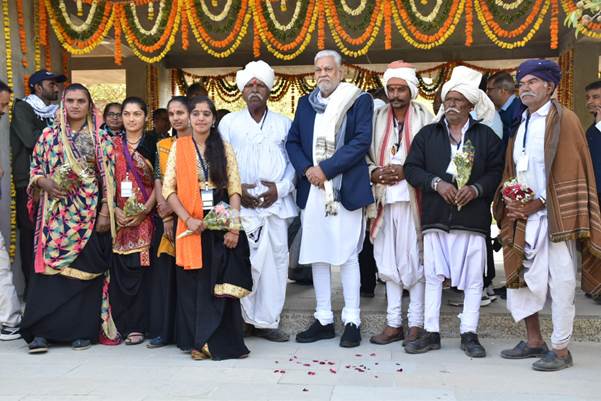
The National Conclave of Pastoral youth drawn from 16 states converged at Bhuj, Kachchh (Gujarat) to discuss their aspirations, challenges and the need for policy discourse with the government. Pertinent to note that Sahjeevan – Centre for Pastoralism holds the lead in piloting several interventions in the sector for the extensive livestock production system. Notable being the camel milk procurement, pastoral breed recognition, conservation of pastoral breeds, artisanal cheese manufacturing with community entrepreneurs etc.
Shri Parshottam Rupala, Union Minister of Fisheries, Animal Husbandry & Dairying has initiated the necessary dialogue and the following initiatives in the larger interest of the Extensive Livestock Production system:
- Inclusion of Pastoral census as part of the national livestock census;
- Creation of a Pastoral Cell within the MoFAHD to focus upon the issues;
- Initial exploration for including extensive livestock production system related schemes and programmes within the National Livestock Mission
It is expected that indigenous wool for acoustics and thermal insulation in the built environment, and the use of wool in the storage and transport of temperature sensitive perishable goods including the institutional interventions for non-bovine milk will find mention in the future initiatives. National Mission on Indigenous wool, Creation of institutional platforms for marketing of non-bovine milk (goat, Sheep, donkey & Yak), Providing identity to the pastoral population and ease of doing business for the pastoral dairy landscape is very much on the cards.
The conclave finds wide representation of officials from the Ministry of Fisheries, Animal Husbandry & Dairying viz.; Dr. Abhjit Mitra – Animal husbandry commissioner, Dr. Sujit Datta – Joint commissioner, Dr. Debalina Dutta – Assistant commissioner and Shri Sumed Nagrare – Statistical advisor, MoFAHD. In order to look at holistic perspective on livelihood and efforts to mainstream the pastoral community and the possible collaborations the conclave was also attended by Dr. A Sahoo – Director, National Research Centre for camel, Dr. Vinod kadam – Central Sheep wool Research Institute, Avikanagar, Dr. Khem Chand – Principal Scientist, National Institute of Agriculture Policy & Research including Shri G S Bhatti – Executive Director, Central Wool Development Board.
Background:
Estimates of the number of pastoralists in India vary widely. Official data on livestock at present do not reflect the management system used. It has been understood that the extensive livestock production system relies on common-pool resources to maintain their animals. A wide range of pastoralist systems exist, from fully mobile to transhumant and sedentary. Species maintained in mobile systems include camels, cattle, ducks, donkeys, goats, pigs, sheep and yaks.
Many pastoralists are members of traditional castes, but other groups, known as “non-traditional pastoralists”, are also engaged with mobile herding. Extensive livestock systems produce a major share of India’s milk and meat. The animals’ manure is also a vital source of fertilizer for crop farmers; for many pastoralists manure is their main source of income.