


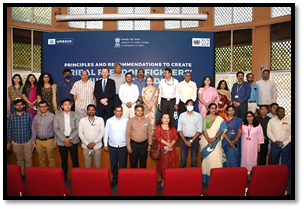
The Ministry of Tribal Affairs (MoTA), Government of India, in joint collaboration with United Nations Educational, Scientific and Cultural Organization (UNESCO) organised 2-day workshop (11th- 12th April 2022) on the ‘Principles and Recommendations to create Tribal Freedom Fighters’ Museums’ at the UNESCO House in New Delhi. The event was coordinated by the United Nations Development Programme (UNDP) who are working on various development projects with the Ministry for last several years.
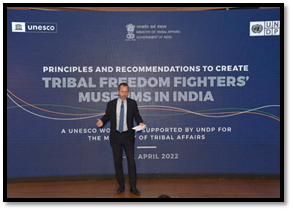
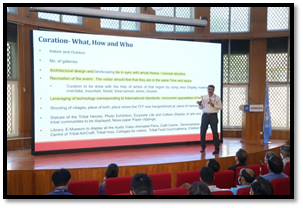
Mr Éric Falt, Director and Representative, UNESCO, in his address complemented the Government of India for this unique endeavour of developing tribal freedom fighters’ museums as this initiative may be the first of its kind in the world. He discussed that the task is complex and gave various Recommendations of how integrity of the project and ownership of tribal communities can be ensured by choosing tribal communities as primary stakeholders and associating them in development of concept, design and visualisation. He explained how ‘Te Papa’ Bicultural and Curatorial Museum of New Zealand is run through the joint ownership of tribals and the Government of New Zealand. Similarly, how the design of National Museum of the American Dream in the United States of America and the New Caledonia Museum in Nouméa are in sync with nature.
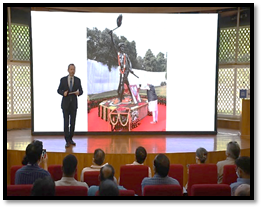
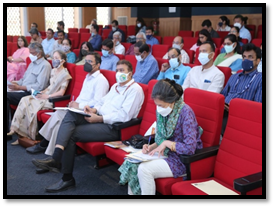
Shri Anil Kumar Jha, Secretary, Ministry of Tribal Affairs said that these museums are meant to recognise contribution of tribals in the freedom movements and preserve their tribal cultural heritage. He said that these museums are being set up in memory of those unsung heroes who contributed in the national freedom movement. The purpose of workshop is to develop a systematic approach to the development of these museums and orient key officials to the inclusive processes necessary in establishing these museums.
Dr Navaljit Kapoor, Joint Secretary, Ministry of Tribal Affairs discussed the progress of various museums across the country. He also shared the learnings from Bhopal workshop which was attended by more than 50 experts across country. The major challenge pointed by the experts was the development and validation of content, community participation so that tribal community develops a sense of ownership with the project.
Ms Shoko Noda, Resident Representative, UNDP said that Tribal Freedom Fighters will showcase the history and create institutions for a future that promotes cultural rights, education, accessibility, livelihoods and social inclusion and contribute to the achievement of the sustainable development goals.”
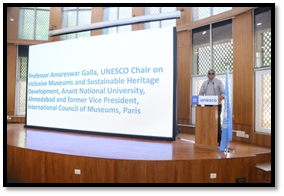
Professor Amareswar Galla, UNESCO chair on Inclusive Museum and sustainable heritage development elaborated on various cardinal principles. Foremost being involving primary stakeholder(s) with representation of credible men and women from the community, the subject matter experts and tribal community leaders.
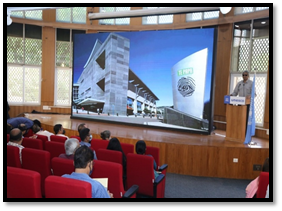
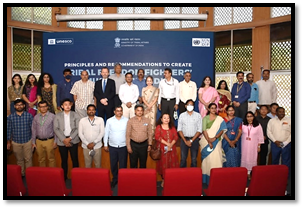
He also highlighted the need to enhance the body of knowledge related to tribal contributions, specifically in relation to the freedom struggle. This could be a tangible or intangible heritage that would be evidence-based context with credible sources. Another recommendation was to promote extensive capacity building for the museum personnel and the local communities in the planning of the museums to foster sustained agency, first voice and ownership. He also discussed ethical principles for safeguarding intangible Cultural Heritage and the Shillong Charter of working with indigenous people from the eight states of North-Eastern
The workshop was attended by directors and representative of Tribal Research Institutes, Anthropological Survey of India, Members of National Level Committee and key experts from Rashtriya Manav Sangrahlya and Indian Institute of Forest Management, Bhopal.