


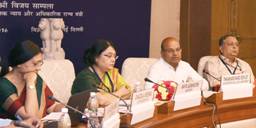
Shri Thaawarchand Gehlot, Minister for Social Justice & Empowerment chaired a Pre-legislative Consultation Meeting on ‘The Persons in Destitution (Protection, Care and Rehabilitation) Model Bill, 2016’ organised by the Ministry of Social Justice & Empowerment here today. Smt. Anita Agnihotri, Secretary of M/o SJ&E and senior officers of the ministry participated in the Presentation and Open Discussion in the meeting. The purpose of the meeting was to seek opinions/views on the Model Legislation drafted by the Ministry and call upon the States/UTs to adopt the legislation.
Addressing on the occasion, Shri Thaawarchand Gehlot said that the Bill will provide protection, care, support, shelter, training and other services to all persons in destitution. The approach of the Ministry towards addressing the problem of destitution/beggary is rehabilitative rather than punitive. He expressed his concern that the number of destitutes are increasing in our country. He called upon all stakeholders to share their views and suggestions for the eradication of the problem of destitution.
Smt. Anita Agnihotri, Secretary of M/o SJ&E in her introductory address dwelt upon the salient features of the Bill.
The Ministry has drafted a Model Legislation for the Persons in Destitution on the basis of recommendations that emerged from the National Consultation Meetings held with State Representatives, Experts in the field of Beggary etc. The objective of the Bill is to provide for the protection, care, support, training and other services to persons in destitution and for establishing agencies to further the objectives identified there under.
As many as 20 States and 2 UTs have either enacted their own legislation or adopted the legislation enacted by other States. However, the provisions of these legislations differ across the States and their status of implementation, including the measures taken for rehabilitation of beggars, is also not uniform. Most of the States/UTs have adopted “The Bombay Prevention of Begging Act, 1959” which criminalizes begging. As per Census 2011, population of Beggars and Vagrants is about 4.13 lakhs (3.72 lakhs non-worker category and 41,453 marginal workers category), details about the population of destitutes are not available.
The meeting was attended by the Representative senior officers of Social Welfare Departments of the State Governments and Union Territory Administrations, representatives from concerned Ministries/Departments, Social Workers, representatives from the Law Commission, Bar Council and reputed NGOs working for the welfare of Destitutes.