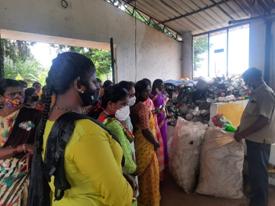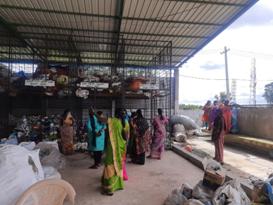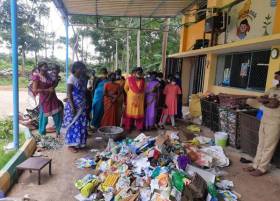
The Mahatma Gandhi Institute of Rural Energy and Development (MGIRED), in collaboration with the Department of Rural Development and Panchayat Raj, the Department of Rural Drinking Water and Sanitation, and the National Rural Livelihood Mission (NRLM), is training 18,000 rural women from Karnataka’s SHGs (Self Help Groups) in various aspects such as solid waste management and solar energy utilisation in rural areas.These women will be engaged as SwachhaKarmikas by their local Gram Panchayats to carry out solid waste management duties like daily waste collection, waste segregation, Swaccha Vahini driving, and so on.

The programme consists of five days of classroom training and exposure trips. The goal of the programme is to provide SHG members with the knowledge and skills necessary to efficiently administer SwacchaSankeerna as a business module and to make the SWM unit self-sustaining, hence providing a source of financial assistance for SHG members.
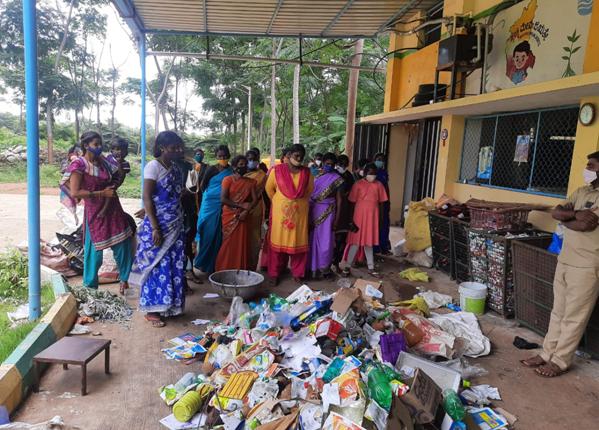
According to Mr. Parameswar Hegde (Director ISA, RDWSD), the classroom training that will be offered in all 30 districts this fiscal year would benefit 18,000 rural women, providing them with an alternative source of income. The programme is free of charge and includes travel, boarding, and accommodation forthree women from each of the Gram Panchayats in Karnataka. This year, 600 batches will be covered with 30 women in each batch, with each batch costing between Rs. 70,000 and Rs. 1 lakh.
SHG members will learn about renewable energy sources, solid waste management, different composting technologies for wet waste, the idea of bio gas for managing biodegradable waste, and the importance of menstrual health and its management after the training. The trained members are expected to carry out duties like as waste segregation, wet waste composting, and biogas unit management at their respective gram panchayats, which they learned during practical demonstrations.
Further, MoUs will be signed with the local GPs for the trained women to be absorbed into the GPLF (Gram Panchayat Level Federation).
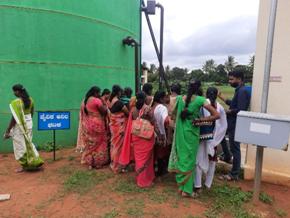
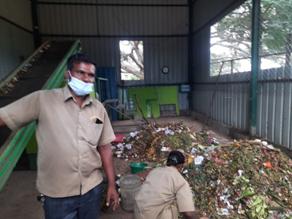
Agenda of the 5-day training programme included:
- Introduction to Energy, Renewable Energy – solar, wind, small hydro, Bioenergy, etc., at MGIRED
- Introduction to waste and solid waste management with activities. This comprised of group discussion, drawing, conducting surveys in the campus, etc., at MGIRED
- Visit to solid waste management unit, at nearby Gram Panchayat for practical exposure on primary segregation, secondary segregation, tendering, etc
- Vermicomposting techniques (theory and practical) at MGIRED
- Visit to solid waste management unit, at nearby Gram Panchayat for practical exposure on primary segregation, secondary segregation, tendering, etc
- Introduction to Biogas Technologies and their maintenance- different models of Biogas units, Government schemes, guidelines and subsidy for biogas plants at MGIRED
- Energy park demonstration at MGIRED
- Maintenance of sanitary pads, alternatives to sanitary pads
- Pipe composting theory and practical at MGIRED
- Visit to Solid Waste Management Unit, at nearby Gram Panchayat for practical exposure on primary segregation, secondary segregation, tendering, etc
- Case studies of biogas bottling plant and biogas to electricity plant and visit to biogas to electricity plant and commercial vermicompost methods at nearby agriculture college
- Assessment and feedback from participants at MGIRED